
Building a business registration website that turns government process into a clear customer journey.
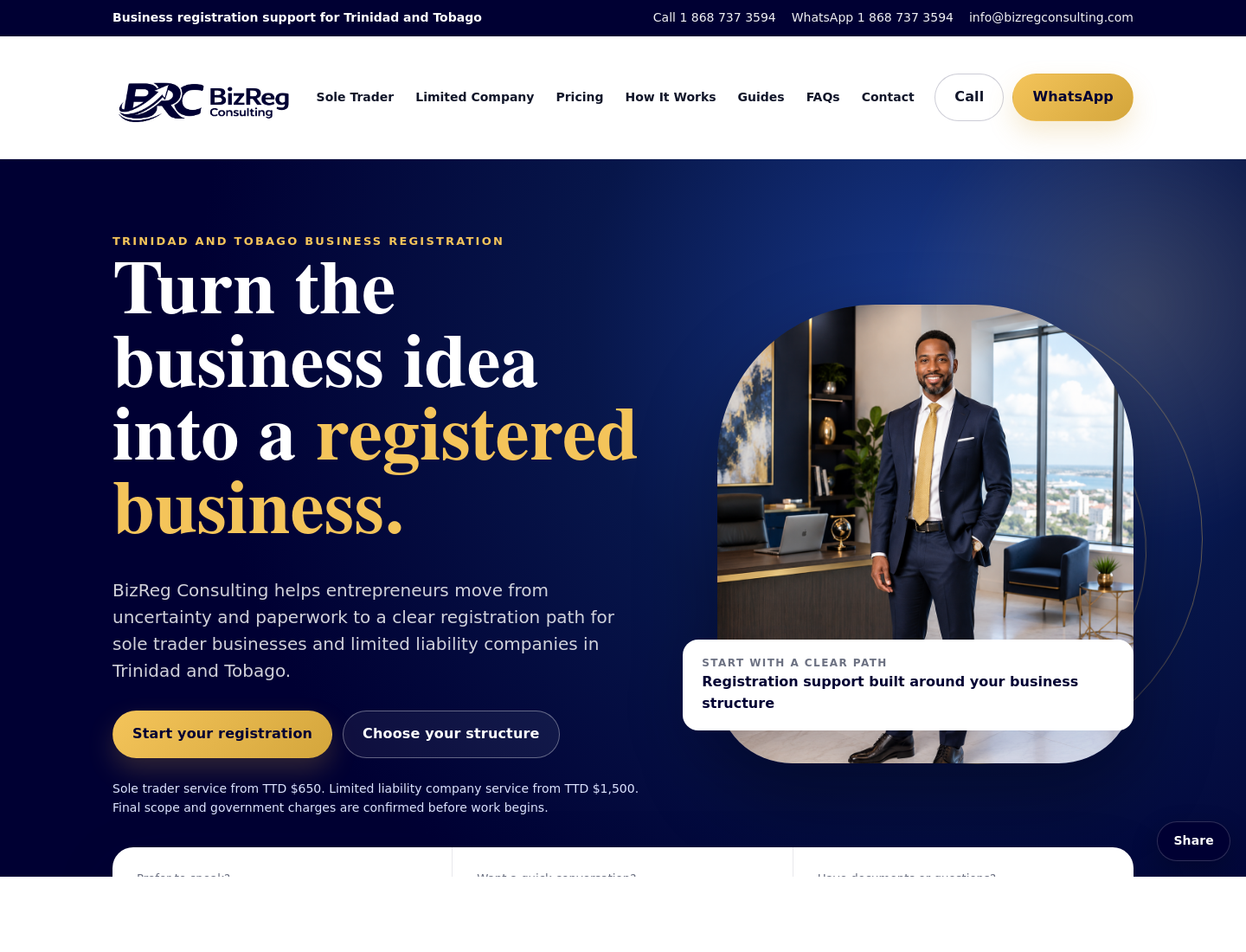
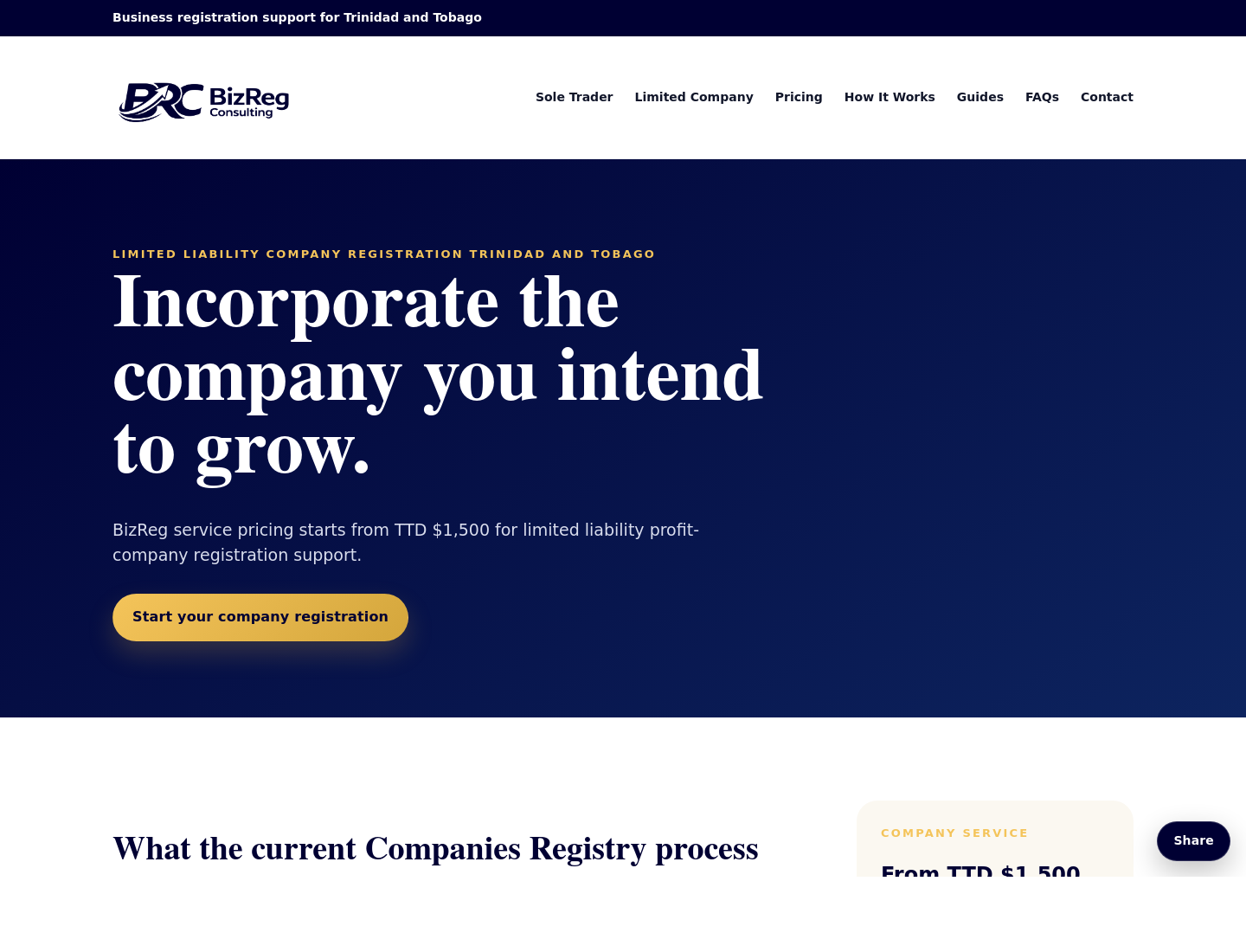
BizReg Consulting needed a public website that could do more than list a registration service. The site had to translate a process involving business structures, government requirements, fees, CROS filings and document preparation into a practical path that an entrepreneur could understand. The live website now separates sole trader and limited company journeys, publishes service pricing, explains official Registry steps, answers high-intent registration questions and gives visitors multiple direct ways to start a conversation.
BizReg Consulting
Sector: Business registration and professional services
Market: Trinidad & Tobago
Primary search theme: business registration website design Trinidad and Tobago
Live website: https://bizregconsulting.com
The commercial problem behind the website
Business registration customers often arrive with procedural questions before they are ready to choose a service. A prospective client may know that a business name needs to be registered, but not whether a sole trader or limited liability company is appropriate, which parts of the process happen through the Companies Registry Online System, what information must be prepared, or which charges are government fees versus professional service fees. That creates a website challenge: if the site leads with a generic list of services, the visitor still has to solve the difficult part alone.
The BizReg Consulting website was structured around that decision problem. The homepage introduces the two main structures an entrepreneur is likely to compare and then explains the relevant process. The result is a professional services website that acts as an orientation layer before the sales conversation begins.
For DSDillon, the design objective was therefore not decorative. It was to reduce ambiguity between research and action. The page needed enough factual depth to answer the questions a serious prospect is likely to ask, while still keeping clear contact and registration calls to action visible throughout the journey.
Information architecture built around sole trader and limited company intent
The live site presents separate pathways for sole trader business-name registration and limited liability company incorporation. That separation is important for both usability and search visibility because the customer intent behind the two searches is different. Someone searching for a sole trader registration route may prioritize simplicity and the ability to begin operating under a registered business name. Someone considering a company may be thinking about a separate legal entity, directors, incorporators and continuing filing obligations.
Dedicated pages allow each topic to explain its own steps, pricing and requirements without forcing one page to carry every possible variation. On the sole trader page, the site explains the Companies Registry Account, name reservation, registration filing and certificate step. On the limited company page, it addresses formation participants, company name reservation, approvals, incorporation filing, signed documents and post-incorporation obligations.
This architecture also creates stronger internal relevance. Instead of one broad 'services' page attempting to rank for every variation of business registration in Trinidad and Tobago, the website can answer more specific searches with a page that directly matches the query.
Separating BizReg service pricing from government charges
One of the clearest trust requirements in a registration service is price transparency. The live website publishes BizReg service pricing from TTD $650 for sole trader registration support and from TTD $1,500 for limited liability company registration support. It also distinguishes those service fees from government filing charges rather than blending the two into one unexplained number.
The site currently references official Companies Registry charges in the context of the process, including company name reservation and profit-company incorporation. It also explains that government charges are separate unless a written quotation expressly says otherwise. That is a small content decision with a large trust impact: a prospective customer can understand what belongs to BizReg and what belongs to the statutory process.
For a professional services website, that distinction is more useful than a vague 'contact us for pricing' page. It lets a buyer self-qualify and reduces the risk that a sales conversation begins with a misunderstanding over what the quoted service includes.
Turning official process into readable web content
The homepage breaks the registration process into readable stages: account creation, name selection and reservation, online filing, and certificate completion. That matters because government systems are designed around statutory workflow and may require additional explanation for customers. A commercial website has to interpret that workflow without misrepresenting it.
The content uses plain language but maintains a boundary between general information and legal or tax advice. The footer states that BizReg provides business-registration support and general information and that current government requirements should be confirmed at the time of filing. That boundary is important because registration fees, processing practices and filing rules can change.
From a website-development perspective, the site therefore combines conversion copy with procedural content. The objective is not to make the process sound effortless. It is to make the next decision clearer.
Search-intent content extends beyond service pages
BizReg includes educational content built around questions entrepreneurs search before they are ready to purchase. The site surfaces guides on how to register a business in Trinidad and Tobago, sole trader versus limited company structure, and annual return obligations. Those topics sit close to the commercial service because they address the exact uncertainty that often precedes a registration engagement.
This is a more defensible SEO strategy than publishing unrelated high-volume articles. Google’s current guidance emphasizes helpful, original, people-first content and the use of words people actually use to search. For BizReg, the natural search vocabulary includes 'register a business in Trinidad and Tobago,' 'sole trader registration,' 'limited company registration,' 'CROS' and questions about company compliance.
The website therefore creates a connected path from informational search to commercial action. A visitor can arrive on a guide, understand the issue, move to the relevant service page and then use WhatsApp, telephone or email to begin the registration conversation.
Conversion design: call, WhatsApp and email without hiding the service
The live website gives visitors three direct communication methods: telephone, WhatsApp and email. Those pathways appear alongside the registration content instead of being isolated on a single contact page. For a local professional service, that matters because different customers have different levels of urgency and confidence. Some want to ask one question on WhatsApp; others want a telephone conversation; others want to send documents or a more detailed inquiry by email.
The calls to action are specific to the task. Phrases such as 'Start your registration,' 'Choose your structure' and 'Start your company registration' are more useful than a generic 'Learn more' button because they tell the visitor what the next action represents.
The website also avoids forcing a lead into a long form before they can speak with the business. That keeps the sales path appropriate for a service where clarification is often necessary before a final scope can be quoted.
What was delivered
BizReg has a live, indexable business registration website with separate sole trader and limited company service journeys, published service pricing, government-process explanations, educational guides and direct contact pathways.
The site also provides a clear market boundary by stating that it serves Trinidad and Tobago. That reduces ambiguity for search engines and visitors about the jurisdiction in which the registration information is intended to apply.
For DSDillon, the strongest proof in this project is the relationship between the business problem and the information architecture. The website demonstrates how a professional service can use factual process content, commercial pricing and conversion pathways in the same experience without turning the site into either a brochure or an unstructured knowledge base.
What this project demonstrates about DSDillon website development
The BizReg project demonstrates DSDillon’s approach to service-business web development: start with the customer decision, identify the questions that block action, create dedicated pages for materially different intent, and make the commercial next step obvious. The work is not based on filling a template with industry text. The navigation and content structure reflect the actual business-registration journey.
It also demonstrates the importance of verifiable content. Where the site discusses Registry fees or procedural requirements, the information is presented as government process rather than as a BizReg-created rule. Where BizReg’s own pricing is shown, it is labeled as service pricing. That separation improves trust and makes the page easier to update when external requirements change.
For businesses evaluating a website developer for professional services, the practical lesson is that design quality and commercial clarity should reinforce each other. A credible website should explain enough to earn the inquiry, not merely display enough to look complete.
Mobile-first decisions for a service that starts with a phone
BizReg’s conversion path is naturally mobile-heavy because the site presents telephone and WhatsApp as immediate contact options. That changes how the website should be judged. A desktop layout can look polished while still failing commercially if a user on a phone has to zoom, hunt for the correct structure or scroll through dense procedural text before finding the next step.
The page hierarchy therefore benefits from short decision blocks, prominent action links and service pricing that can be understood without opening a separate document. The registration process is sequential, so headings and numbered steps help a mobile reader move through the page in manageable pieces rather than confronting one long legalistic explanation.
This is a useful design lesson for other professional services in Trinidad and Tobago. When the likely next action is a call or WhatsApp message, mobile usability is not an accessory to the desktop site; it is part of the sales process itself.
Project record
This record reflects the public BizReg website and the implementation work completed by DSDillon in September 2026. Government-process references remain general information, and private customer information is excluded.
Traffic, keyword, registration, lead and revenue results can be added when publication-ready data is available.
The case study focuses on the reasoning behind the build and the delivered customer experience.
See the work in its current form
The screenshot records the public website at the time this case study was prepared. Because websites, products, programs and promotions can change, the live destination is the best place to review the current experience.
Need a website built around a commercial problem?
DSDillon designs websites around customer needs, business credibility, search visibility and measurable conversion paths.