
Black Market Action, built to move.
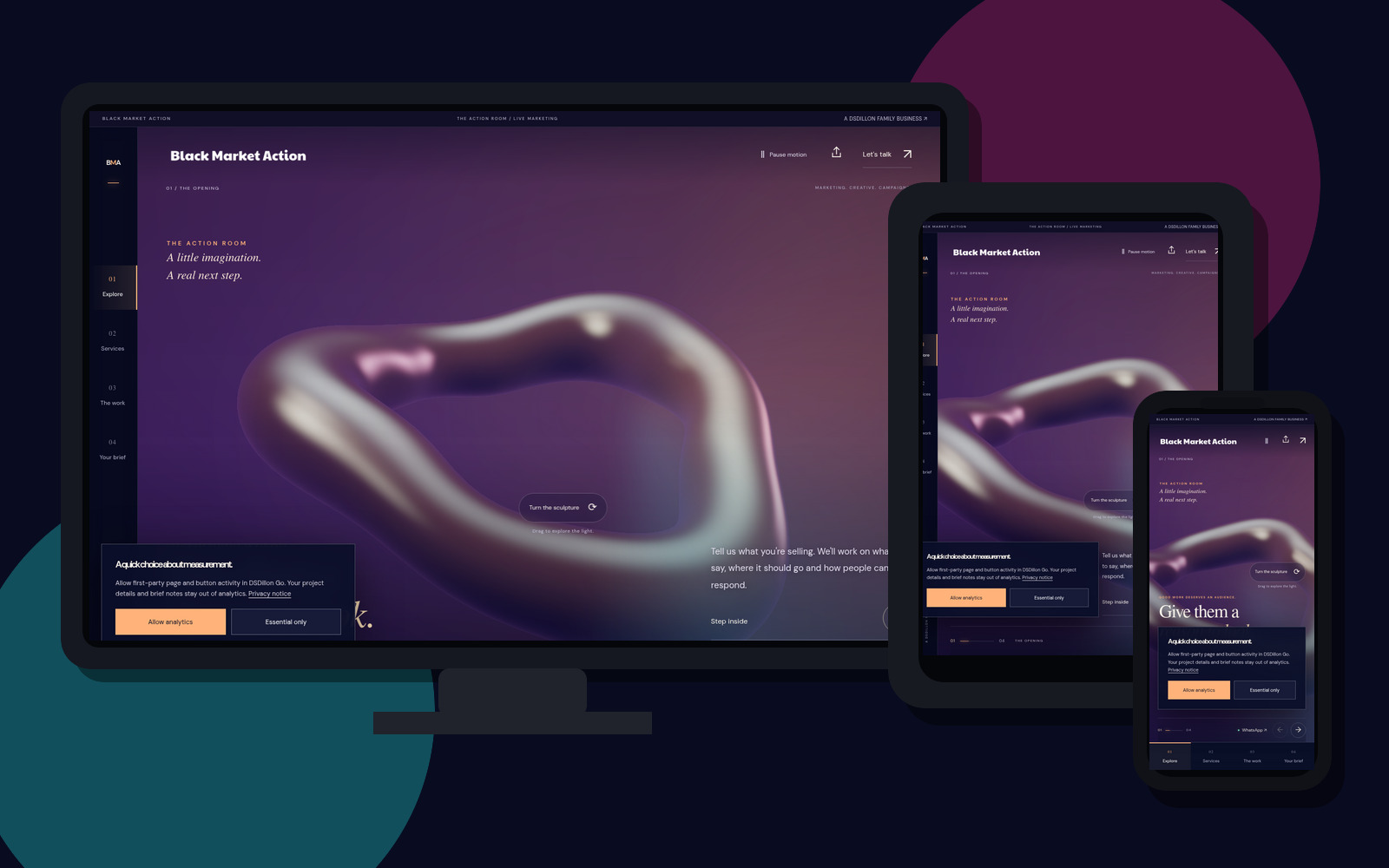
Black Market Action returned without pretending that a complete original website had survived. DSDillon retained the recovered Black Market Action identity, rebuilt the business around researched marketing services and then pushed the visual system into a cinematic web experience. The homepage now moves through four connected scenes, the inner pages carry their own interactive colour and motion language, real DSDillon-family projects appear inside desktop, tablet and phone mockups, and the property has its own first-party reporting profile.
Black Market Action
Sector: Marketing strategy, advertising, content, landing pages and measurement
Market: United States and Trinidad & Tobago enquiries; project arrangements agreed individually
Primary search theme: interactive marketing website design
Live website: https://blackmarketaction.dsdillon.com/
Reconstructing from verified fragments, not inventing a past
The Black Market Action project began differently from the other website recoveries. The hosting and backup inspection did not produce a complete set of original WordPress pages or a usable historical database. What could be verified was the Black Market Action business identity and its original logo, which remained available in the DSDillon media archive.
That meant the public website could not honestly be presented as a pixel-for-pixel restoration of an earlier site. DSDillon treated the project as a reconstruction: preserve the verified identity, document the recovery limitation and build a current marketing website around services and customer questions that could be supported today.
The finished About page explains that distinction directly. Historical fragments are identified as historical fragments, while the current service copy, tools and visual system are described as part of the new build.
A homepage designed as a guided sequence
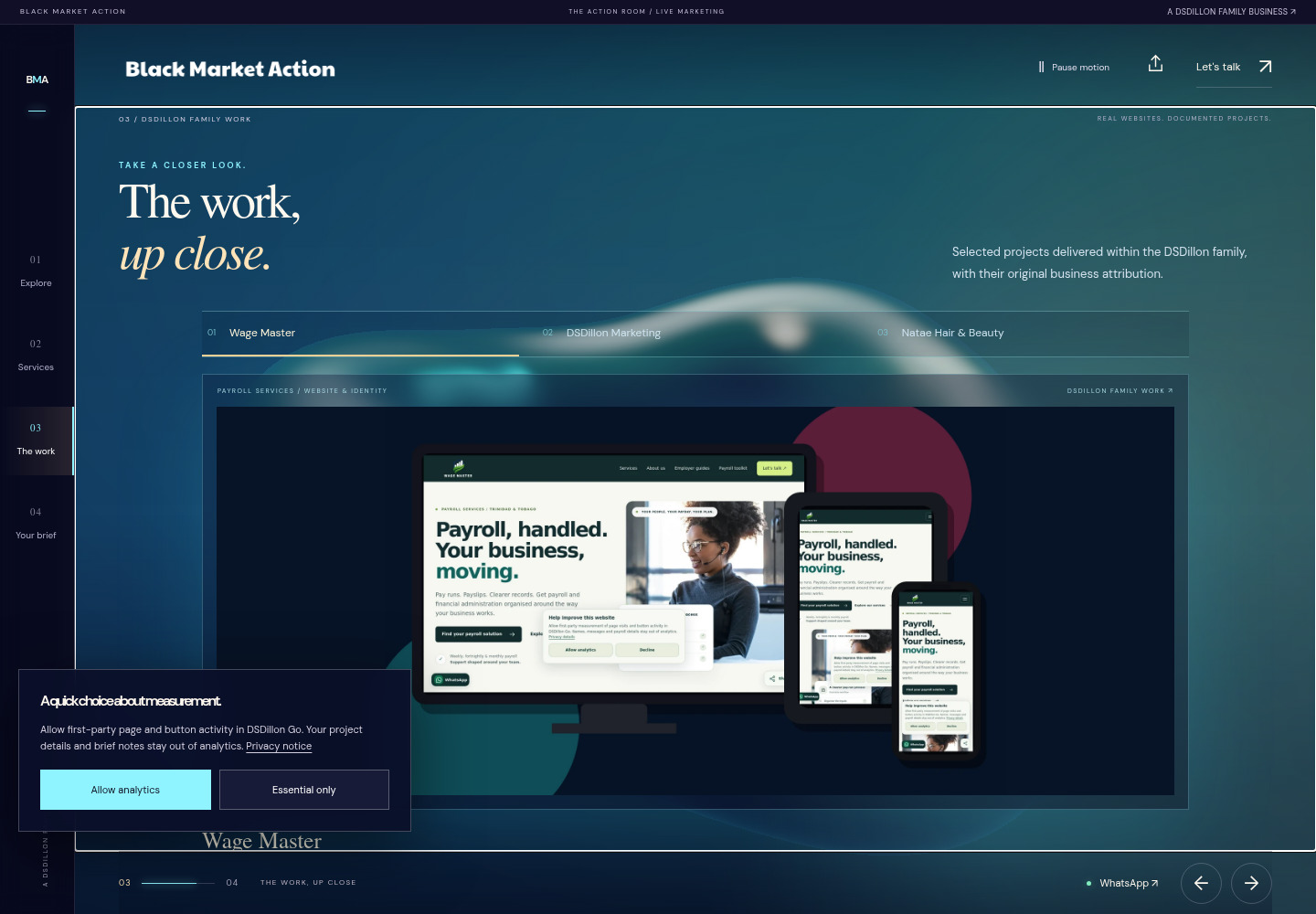
The final homepage is called The Action Room. Instead of asking a visitor to scroll through a familiar sequence of hero, cards and testimonials, it moves through four connected scenes: The Opening, Services, The Work and Your Brief.
Moving between those scenes changes the camera treatment, depth, blur, temporary letterboxing, lighting and colour environment. The background shifts from violet, pink and turquoise into orange and magenta, then cyan and electric blue, and finally yellow, green and teal. The transition is intended to feel continuous rather than like four unrelated pages.
The same navigation works from the scene rail, the chapter controls, keyboard arrows and desktop wheel movement. On smaller screens the navigation becomes a four-part bottom rail. Reduced-motion preferences and the visible motion control keep the effect optional rather than mandatory.
Rebuilding the 3D centrepiece for a cleaner result
An earlier concept used a low-resolution sculptural object that looked jagged around the edges. The production version replaced that treatment with a higher-resolution WebGL renderer, hardware antialiasing, higher device-pixel rendering and a finer signed-distance-field surface calculation.
The metallic form can be turned or dragged, and its reflected colour changes with the current scene. It is not a stock video or decorative screenshot. It is rendered in the browser and tied to the same scene state that controls the page atmosphere.
Carrying the cinematic language through the rest of the website
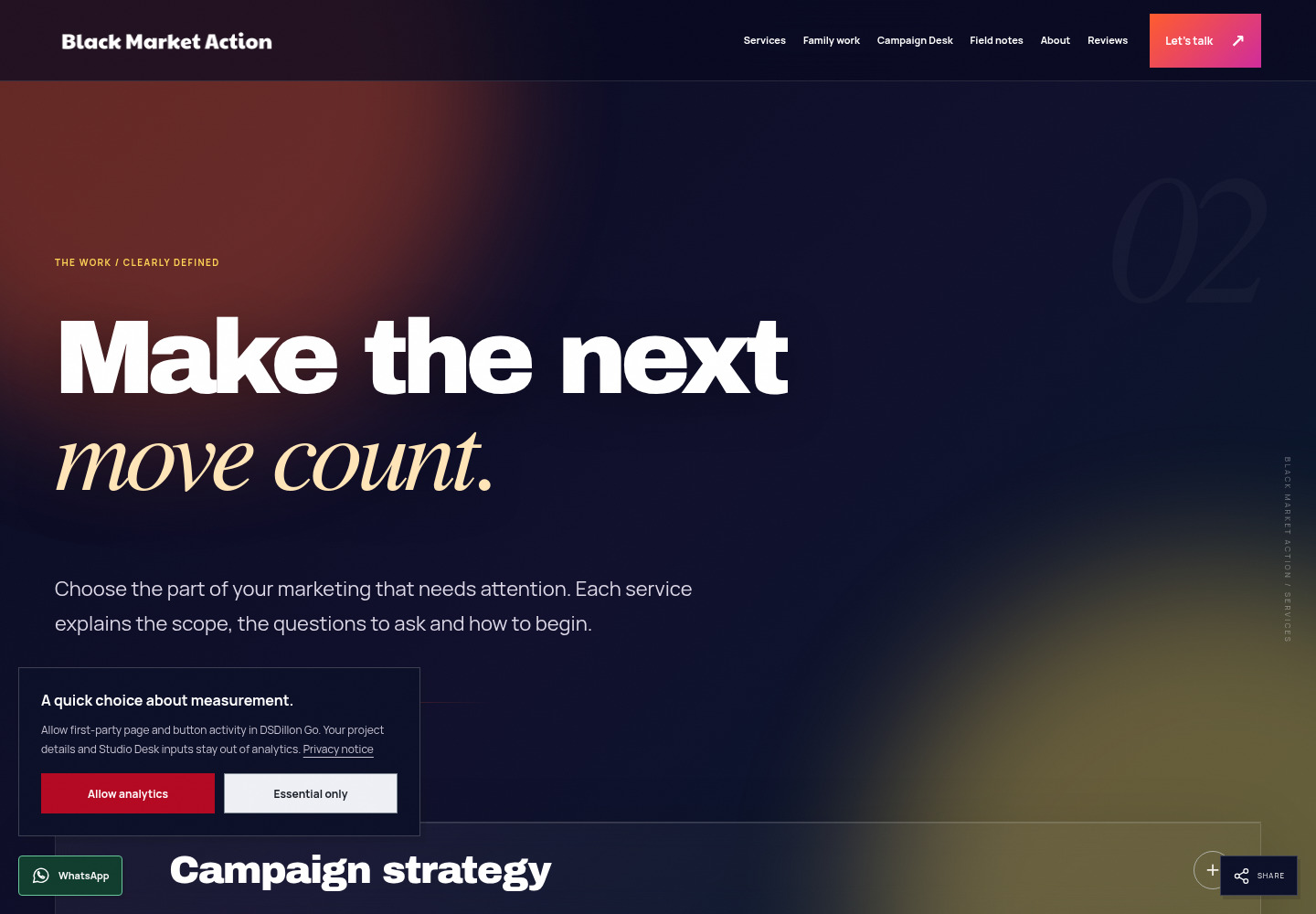
The homepage was only the first step. The service pages, project pages, About, Campaign Desk, Field Notes, Reviews, Contact and policy pages were then given a shared cinematic layer while keeping their existing URLs and researched copy.
Each page family has its own colour treatment. Services use orange, magenta and gold; project pages use cyan and electric blue; Field Notes use purple, pink and green; Contact uses yellow, green and teal. Content panels use translucent depth, sections reveal as they enter the viewport and internal navigation uses a short transition between pages.
A first version of that layer briefly showed the previous design before JavaScript applied the new classes. The fix moved the cinematic state into the HTML delivered by the server. The pages now arrive already carrying their final visual class, so the browser does not need to paint the old design before switching.
Showing responsive work as responsive work
The project gallery originally used wide screenshots. That flattened responsive websites into a single banner and made it difficult to see how the work behaved on different screens.
Fresh live captures were therefore taken for Wage Master, DSDillon Marketing and Natae Hair & Beauty at desktop, tablet and phone sizes. Each project now appears as a three-device composition, both in the Action Room and throughout the related project previews. The case-study lead image uses the same principle for Black Market Action itself.
Useful content behind the motion
The visual work sits on top of a full marketing information architecture rather than replacing it. The sitemap contains 28 public URLs, supported by six service areas and a Field Notes library covering campaign planning, advertising budgets, weak enquiry journeys, social-media deliverables, local visibility and website readiness.
The Campaign Desk gives a prospective client practical ways to prepare before making contact. The project brief can be saved on the visitor's device, and the launch checklist provides a structured starting point. The homepage also lets a visitor choose a service and keep a starting brief without sending the written notes into analytics.
Search metadata, canonical addresses, structured information, crawl controls and the sitemap remain part of the published site. The main content is delivered as HTML rather than being hidden behind the cinematic effects.
Contact, reviews and clear attribution
Black Market Action uses 1 (302) 339-1954 and info@dsdillon.com for direct contact. The contact experience keeps the existing structured enquiry flow and server-side checks, while the homepage provides telephone, email and WhatsApp routes from the final scene.
The site also preserves 89 entries from the DSDillon family's archived review collection: 64 Google reviews and 25 Facebook recommendations. They are presented with their original source context and are not relabelled as 89 Black Market Action customers.
The project examples are similarly labelled as DSDillon family work. Their own records and live sites remain linked so a visitor can inspect what was actually delivered.
Separate first-party reporting
Black Market Action has its own active first-party website reporting profile. Optional first-party measurement can record permitted page visits, presence, realtime activity, conversions, performance signals and sharing activity.
Measurement begins only after the visitor allows analytics. The integration respects Do Not Track and Global Privacy Control, uses host-specific consent and keeps written project details and Campaign Desk inputs out of analytics. Cross-property identity matching is disabled for this site.
The production homepage keeps the existing first-party measurement connection after the cinematic redesign, so the visual rebuild did not create a second or disconnected reporting profile.
What was checked before publication
The inner-page cinematic system was checked across 28 routes at desktop and mobile widths, producing 56 route-device checks with no horizontal overflow or JavaScript errors. Additional interaction checks covered the mobile menu, service accordion, project mockup dialog and the contact page's 12 form controls.
The Action Room received a separate transition test across desktop, mobile and small-phone viewports. All 12 tested scene changes completed with one active scene at a time. The production homepage was then checked again at desktop and mobile sizes for indexable robots settings, the canonical URL, WebGL rendering, overflow, analytics availability and visitor-choice controls.
The case-study screenshots shown here were captured from the published website. The earlier site files and a pre-cinematic backup remain on the owner's server for rollback and project evidence.
Launch record
This case study documents recovery research, design, custom development, responsive presentation, interaction testing and the first-party measurement connection.
Post-launch reporting can track traffic, search visibility, qualified enquiries and business outcomes across a defined measurement period.
See the work in its current form
The screenshot records the public website at the time this case study was prepared. Because websites, products, programs and promotions can change, the live destination is the best place to review the current experience.
Need a website built around a commercial problem?
DSDillon designs websites around customer needs, business credibility, search visibility and measurable conversion paths.