
BookzCentral, rebuilt for discovery.
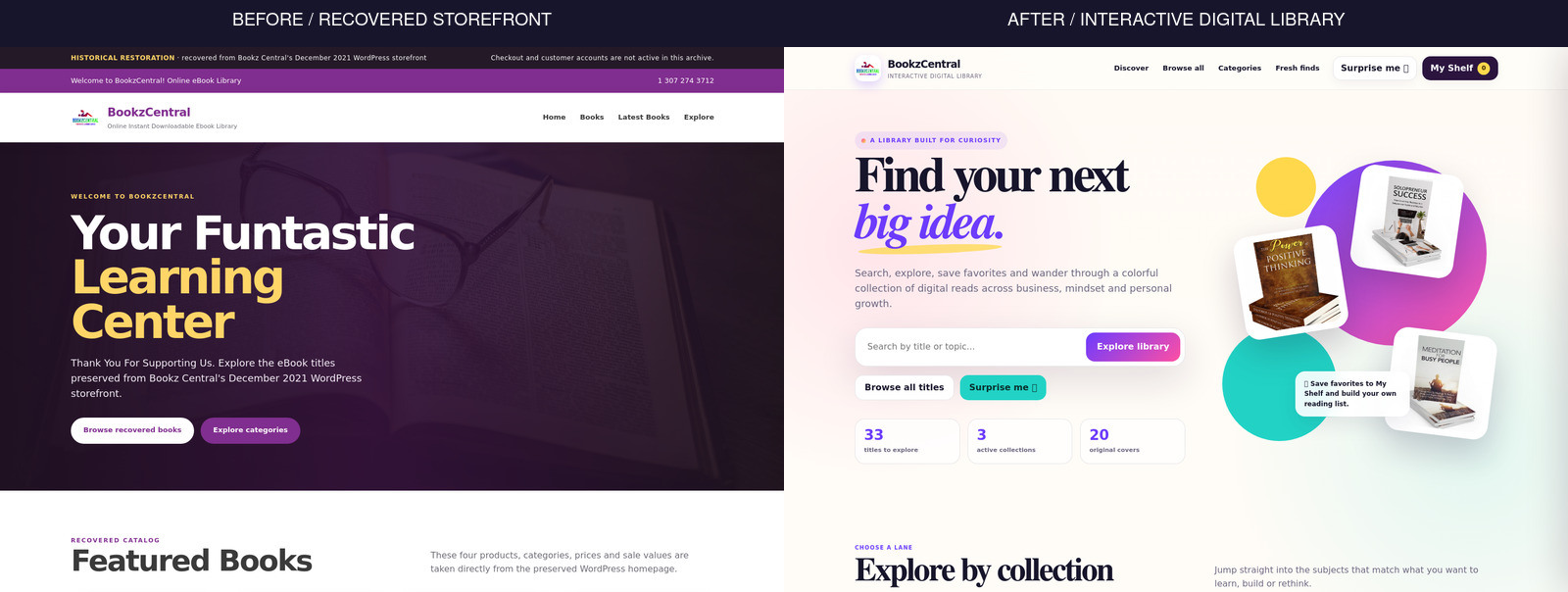
BookzCentral returned in two stages. First, DSDillon recovered the public evidence that still existed after the original WordPress/WooCommerce database had disappeared. That work restored 33 verified titles, the original BookzCentral identity, surviving cover art and historic product routes. The second stage replaced the dated storefront with a digital-library experience. BookzCentral was redesigned as a bright, premium interactive digital library built around discovery: live search, category browsing, Quick Peek previews, a persistent My Shelf feature and a Surprise Me pathway for readers who want to explore.
BookzCentral
Sector: Digital library, eBooks, educational content and online discovery
Market: Online digital audience
Primary search theme: interactive digital library website
Live website: https://bookzcentral.dsdillon.com/
Recovering the real BookzCentral before redesigning it
The BookzCentral server record still existed, but the original WordPress/WooCommerce database and a usable Softaculous backup did not. Rather than rebuild from memory, DSDillon traced the project through the account's historical access logs and Internet Archive captures.
That research confirmed that BookzCentral had moved through more than one platform. An earlier Shopify-era version was visible in 2021, while a later WordPress/WooCommerce storefront used the Motocom bookstore theme. The later WordPress version was chosen as the recovery reference because it was closer to the site that existed before the domain disappeared.
The 21 December 2021 WordPress homepage supplied the strongest public record. It preserved BookzCentral's identity, storefront structure, category names, product links, prices and many of the original covers. Additional archived assets and one complete product page provided further evidence.
What survived — and what did not
The recovered homepage exposed 33 distinct product listings across Business, Mind and Body & Spirit. Twenty original book-cover files were recoverable from the archive. The remaining titles retained their real names and categories but initially used clearly marked archive placeholders rather than fabricated covers.
The historic commerce backend did not survive. Customer accounts, order history, checkout data, wishlist data and the original WooCommerce database were therefore not recreated. During the recovery stage, the old commerce routes were represented honestly as historical status pages rather than fake transactional features.
A total of 54 static routes were rebuilt so the recovered homepage did not terminate in dead links. Original product paths were retained, along with category routes and legacy library paths.
Changing the job of the website
Once the historical recovery was secure, the brief changed. BookzCentral no longer needed to look like an old online shop. It needed to feel like a modern place to discover ideas.
The redesign removed the visible phone number and shifted the interface away from prices, carts, wishlists and account language. The new homepage opens with 'Find your next big idea.' and treats the catalog as a browsable digital library.
The visual system became brighter and more expressive: saturated violet, hot pink, aqua, coral and sunshine accents sit over a warm cream background, while deep plum and navy provide contrast. The result keeps BookzCentral recognizable without carrying over the dated visual language of the restored storefront.
Discovery became the core interaction
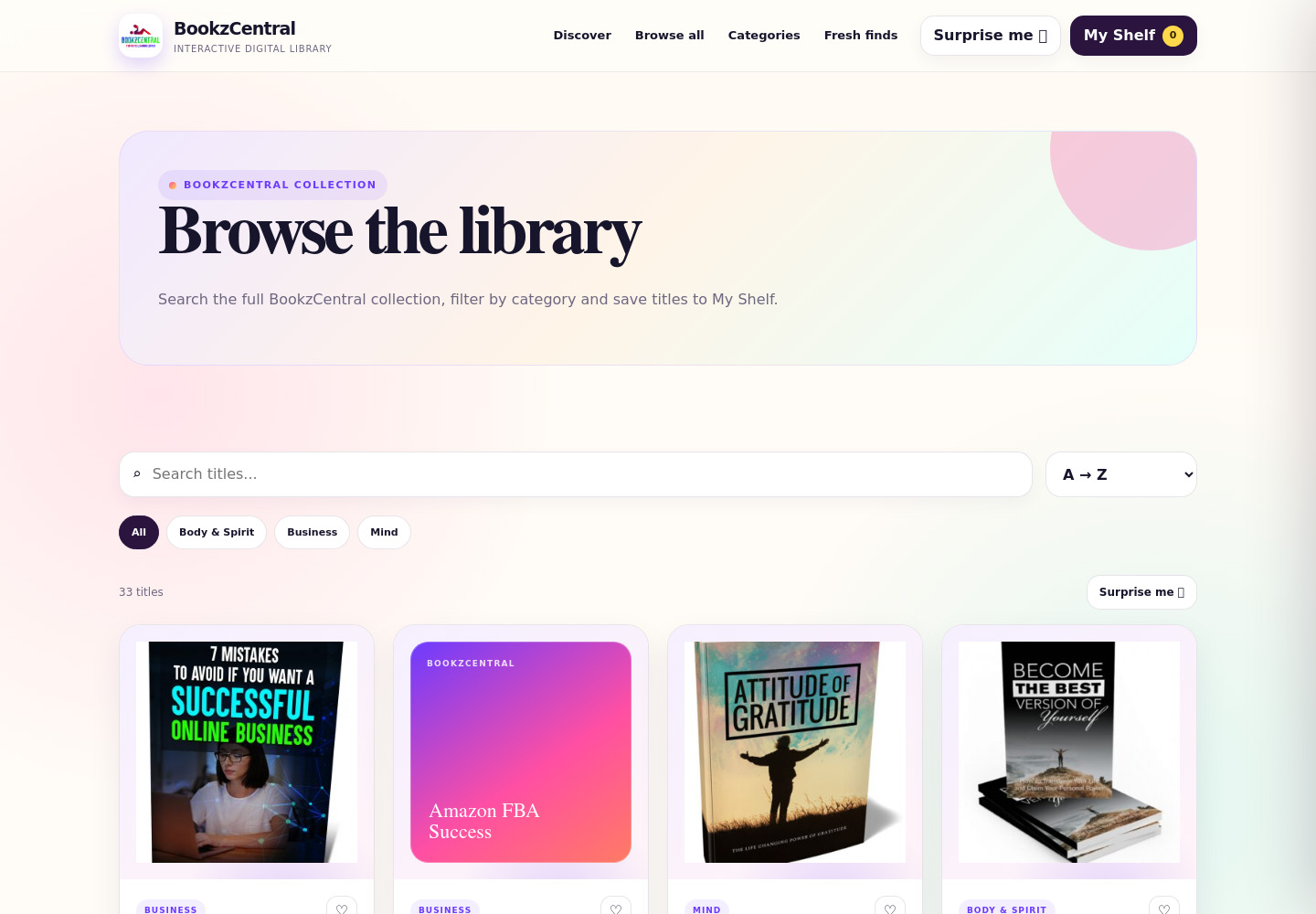
The new library is designed around exploration. Visitors can search the catalog by title or topic, filter by collection, sort alphabetically or by category, and move directly between Business, Mind and Body & Spirit.
A Surprise Me control selects a random title for readers who do not arrive with a specific book in mind. Quick Peek opens an in-page preview without forcing the visitor to leave the library grid.
My Shelf replaces the old wishlist concept with a simpler discovery tool. A visitor can save a title with the heart control, open a dedicated shelf drawer and keep those selections on the same device through local browser storage. No account is required.
A richer homepage without losing usability
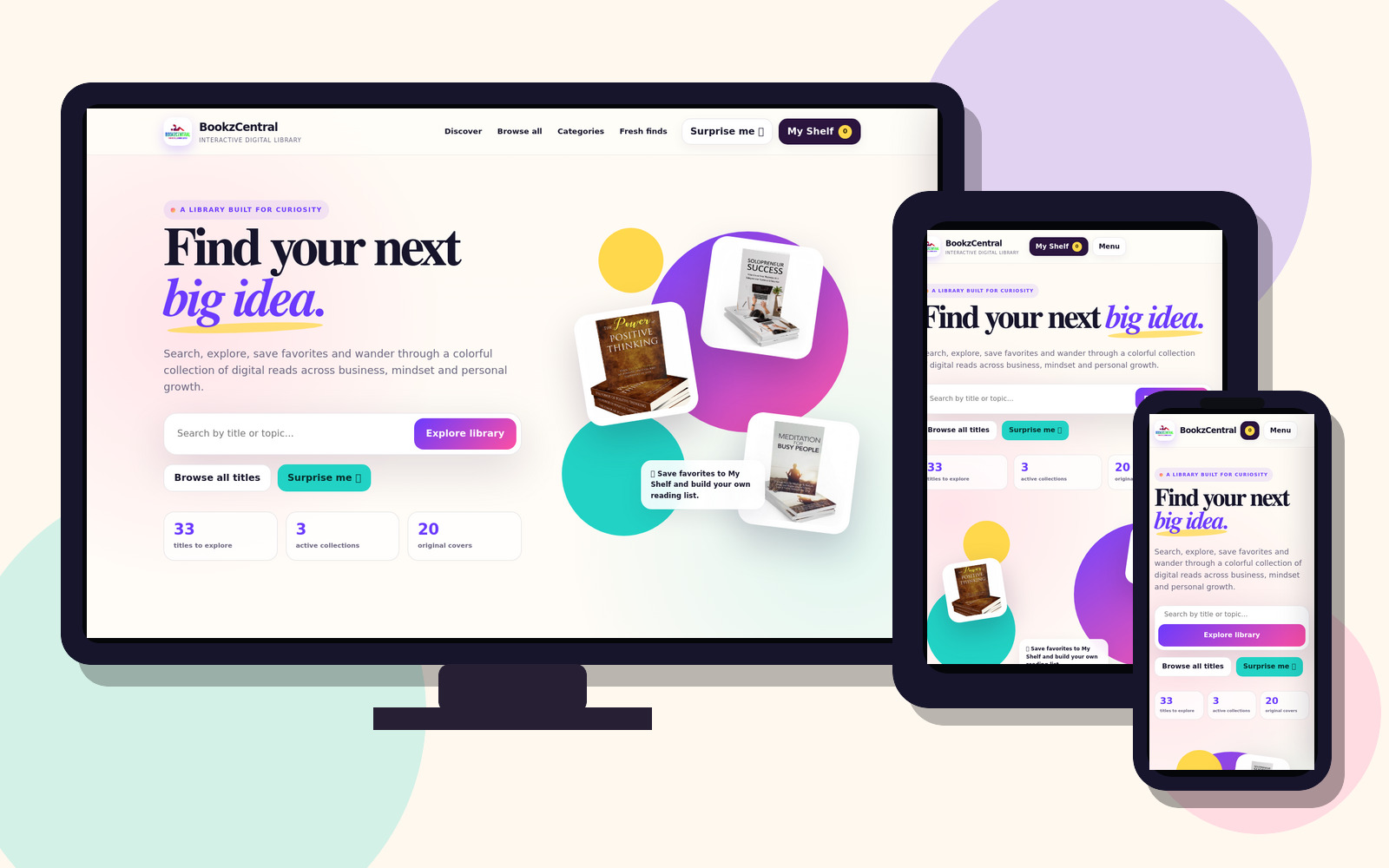
The homepage uses layered circular color fields, floating book covers, category tiles, discovery panels and responsive book cards to create movement without turning the library into a novelty interface.
Featured Shelf and Fresh Finds provide curated entry points, while the three main collections use different color environments. The design is playful, with familiar search, navigation and book-access patterns.
Where an original cover exists, the live library uses it. Where the source archive did not preserve a cover, the redesigned site uses a branded BookzCentral fallback treatment rather than pretending an invented cover is original.
Individual title pages were rebuilt for browsing, not checkout
Each of the 33 recovered product URLs now opens as a current BookzCentral title page. The page presents the cover or branded fallback, category, title, a short library description and routes to save the title, browse the category or continue to another book.
The only complete long-form historic description available in the archive belonged to Solopreneur Success. That recovered description informed the current summary for that title. Other books are not padded with invented historical copy.
The page also states that BookzCentral is currently focused on discovery and collection building. Download and reading access are not falsely presented as active where those systems do not exist.
Search and technical structure
The redesigned site is indexable rather than locked behind the noindex protection used during the initial historical recovery. Each major page has a canonical URL, current title and description metadata, and the library publishes a sitemap.
The homepage includes WebSite search structured data. The full library uses CollectionPage and ItemList markup, while individual title pages use Book structured data. The content remains server-delivered HTML, so the catalog is not dependent on JavaScript for basic crawlability.
The original legacy WordPress administration paths remain retired. The current site is a static custom build, which removes the need to restore the missing WordPress database simply to keep the public library online.
What was verified before publication
The redesigned build was tested at desktop and mobile widths across the homepage, full library, Fresh Finds, category explorer, representative title pages, active category pages and the custom 404 experience. Those checks found no horizontal overflow, no JavaScript errors and no broken displayed images after full-page image loading.
Interaction testing confirmed live search, mobile navigation, Quick Peek, My Shelf saving, the shelf drawer and saved-book persistence after reload. A separate public sweep checked all 54 published HTML routes, and all 54 returned successfully.
The requested phone number removal was also verified programmatically across public HTML, CSS, JavaScript, JSON, XML and text assets. The final scan returned zero matches.
What this case study records
This case study documents the recovery evidence, the limits of what survived, the preservation of 33 real titles, the shift from storefront to library, the custom interactive features and the publication checks performed before launch.
Post-launch measurement can track readership, search visibility and commercial outcomes over time.
See the work in its current form
The screenshot records the public website at the time this case study was prepared. Because websites, products, programs and promotions can change, the live destination is the best place to review the current experience.
Need a website built around a commercial problem?
DSDillon designs websites around customer needs, business credibility, search visibility and measurable conversion paths.