
Rebuilding DayneDillon.com into a Delaware-focused advisory website and measurable customer-acquisition platform.
DayneDillon.com was rebuilt as a Delaware-focused business advisory website rather than left as a broad legacy web presence. DSDillon migrated the public property from WordPress to a standalone Next.js application, clarified Wilmington as the physical headquarters and Lewes as a service area, reorganized the site around high-intent business questions, connected Search Console and DSDillon analytics infrastructure, and completed responsive QA across the public experience. The project also demonstrates the value of production-level debugging: an intermittent iPhone header-logo issue was traced to an unusual 16-bit PNG encoding and corrected without changing the brand design.
DayneDillon
Sector: Business advisory, web development, local visibility and commercial intelligence
Market: Wilmington, Lewes and Delaware
Primary search theme: Delaware business consulting website design
Live website: https://daynedillon.com
The project started with a positioning problem, not a visual redesign
DayneDillon already had an established web property, but the site needed to communicate a much more specific commercial role. The rebuild had to make clear that the business serves Delaware companies through business consulting, websites, local visibility, business email and commercial intelligence, while avoiding the ambiguity that comes from presenting too many unrelated capabilities with equal weight.
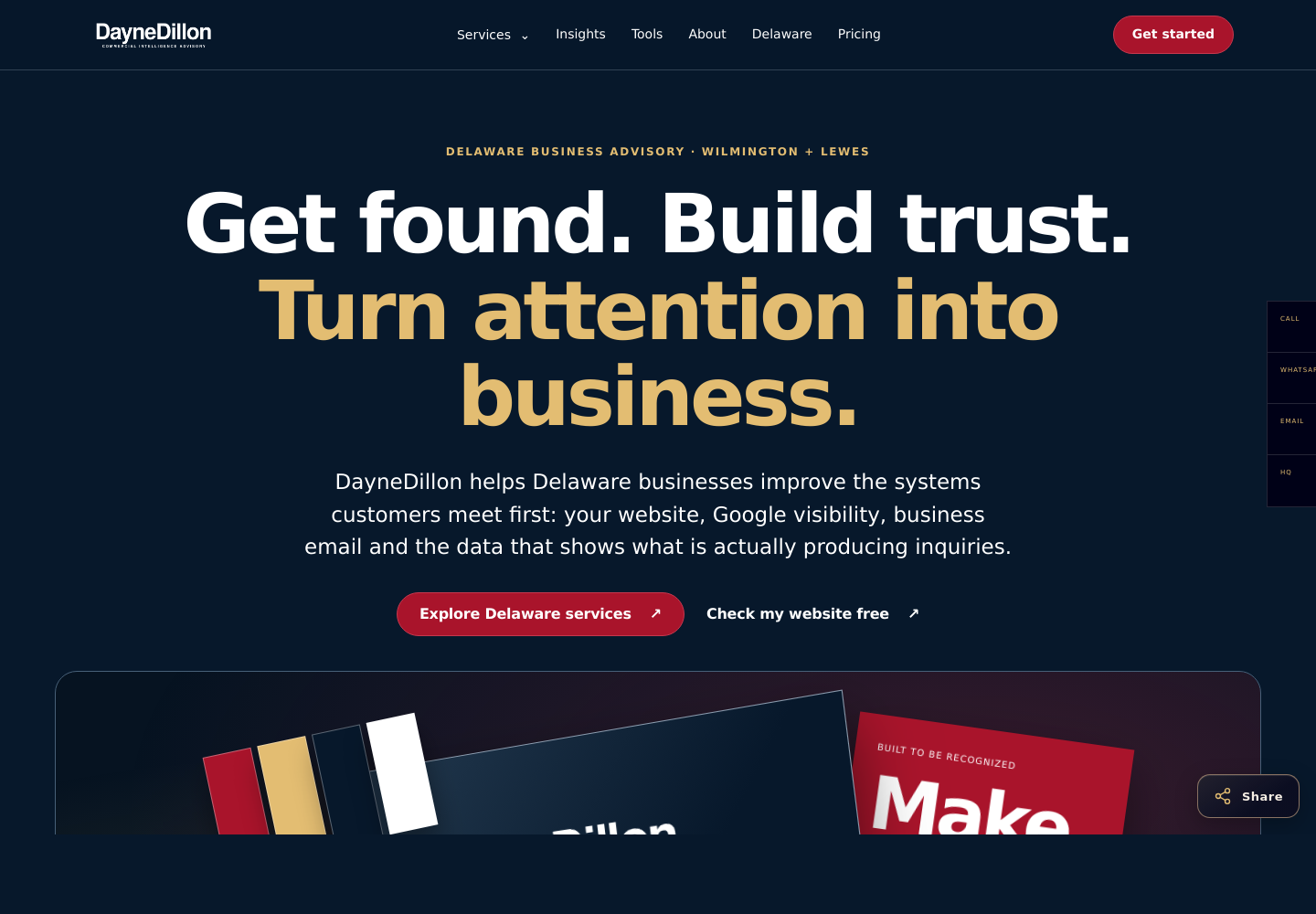
DSDillon treated the project as a positioning and information-architecture exercise before treating it as a design exercise. The homepage was rewritten around a simple promise: help businesses get found, build trust and turn attention into business. Supporting copy then explains the systems customers encounter first, including the website, Google visibility, business email and the measurement layer used to understand inquiries.
That decision gave the website a commercial hierarchy. Visitors do not have to infer what DayneDillon is from a catalogue of services. The site first explains the business problem, then provides routes into the specific capability that can address it.
Migrating from legacy WordPress to a standalone Next.js production site
The public property was moved away from its former WordPress installation and rebuilt as a standalone Next.js application. The migration changed more than the rendering framework. It created a controlled production surface where routing, metadata, structured data, analytics hooks, responsive behavior and reusable components could be managed as one application.
The new deployment runs behind the existing DayneDillon domain and preserves the public identity while replacing the legacy content-management runtime. This approach reduces the number of moving parts in the public presentation and gives DSDillon direct control over the code that determines navigation, service pages, technical SEO and tracking behavior.
The migration was completed without treating the new framework itself as the business outcome. The meaningful result is that the public website now has a maintainable architecture capable of supporting search-intent pages, pricing, tools, analytics and future integrations under one consistent brand system.
Wilmington headquarters and Lewes service area are deliberately distinguished
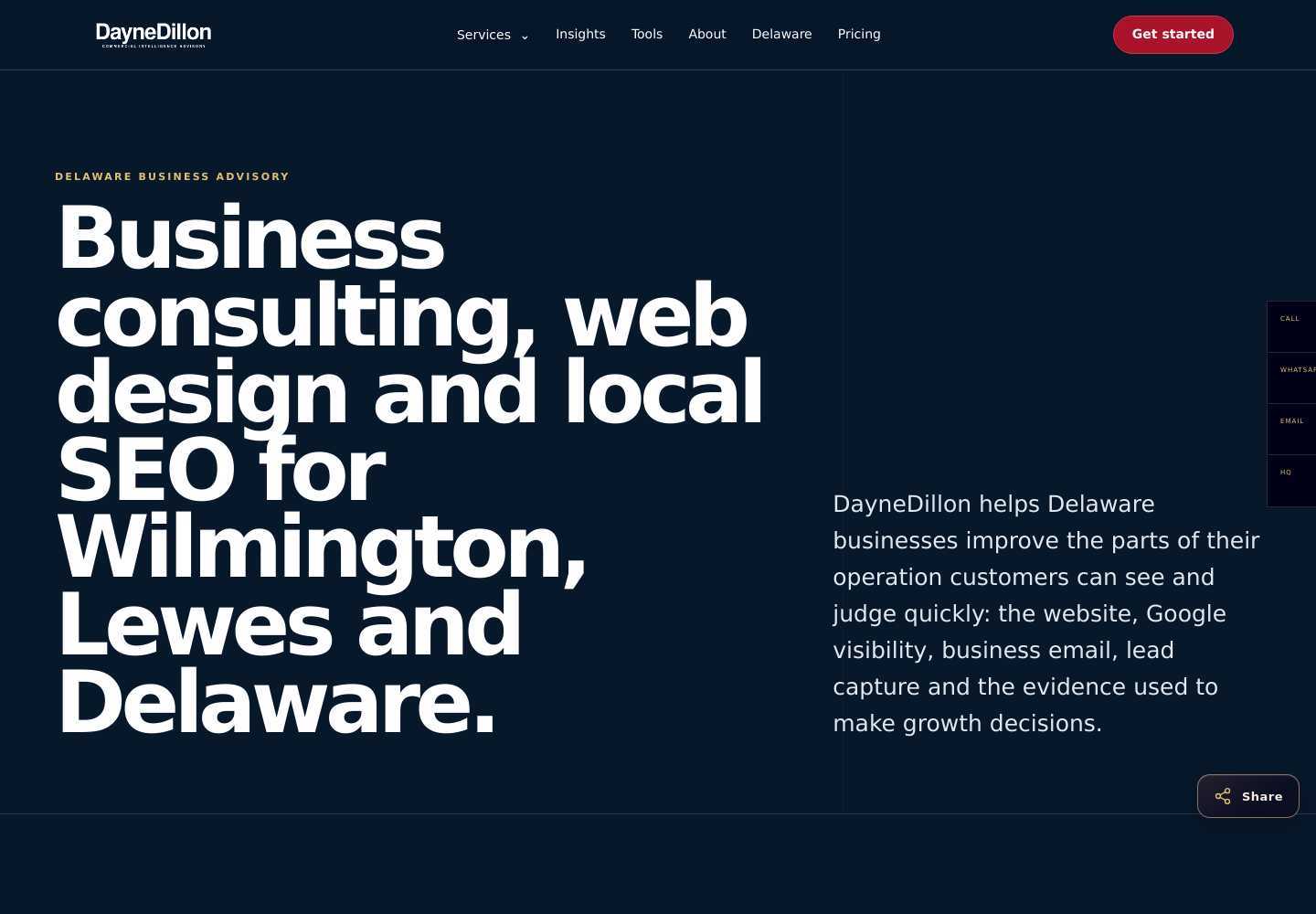
Local-business websites can create trust and search problems when they imply physical offices that do not exist. DayneDillon has one physical Delaware office in Wilmington, while Lewes is a service area. The rebuilt site identifies Wilmington as the physical office and Lewes as a service area.
Dedicated Delaware, Wilmington and Lewes pages address geographic intent while keeping Wilmington as the physical office and Lewes as a service area. Wilmington can carry the headquarters address and direct local context, while Lewes can explain availability to businesses in that market as a service area. The same principle applies to structured data and page copy so that users and search systems receive consistent location signals.
This is an important local-SEO design choice. Geographic relevance should come from truthful operational coverage, not from multiplying addresses or creating location claims simply to target a keyword.
Service architecture was rewritten around questions businesses actually ask
The rebuilt site separates major commercial needs into focused destinations: business consulting, websites, business visibility, business email, commercial intelligence, real estate advisory and executive security advisory. The objective is not to maximize the number of pages. It is to give materially different search and buying intents their own clear path.
Website content addresses questions around cost, timelines, ownership, maintenance and whether a site is generating inquiries. Visibility content addresses Google Business Profile, Maps, local SEO and the common problem of a business not appearing where expected. Business-email content addresses setup, reliability and professional identity. These topics are closer to the language a prospective customer uses when trying to solve a problem than a generic agency services list.
Internal linking then connects related questions, services, tools and insights. A visitor can move from a diagnostic problem to a relevant advisory page without being forced back through the homepage for every decision.
The homepage is designed as a decision surface
The DayneDillon homepage uses a restrained dark-blue, gold and burgundy visual system, but the design is subordinate to the decision path. The primary message is followed by direct actions to explore Delaware services or check a website, while navigation exposes services, insights, tools, company information, Delaware coverage and pricing.
The visual system also supports trust through consistency. The same logo, typography, spacing, button language and header behavior are used across the public experience. This matters because a visitor may enter on a service page from search rather than begin on the homepage; the site still needs to feel like one coherent business property.
Calls to action are written around the next task instead of generic interaction labels. That keeps the interface commercially useful while allowing informational pages to remain useful on their own.
Search infrastructure was connected to the production website
The new DayneDillon property was connected to Google Search Console as a domain property and the XML sitemap was submitted after the rebuild. Canonical URLs, indexability controls, structured organization data and service-area signals were aligned with the new Delaware positioning.
DSDillon also connected the site to its internal Search Intelligence and website-analytics systems. That creates an operational layer behind the public pages so technical findings, search visibility and user journeys can be reviewed as the site evolves rather than treated as a one-time launch checklist.
A final internal Search Intelligence technical audit examined 120 pages and returned zero findings at the time of certification. That is an implementation check, not a ranking promise. Search performance still depends on competition, relevance, authority, content quality and time.
Measurement is part of the build, not an afterthought
DayneDillon was registered as its own public website surface in DSDillon’s first-party analytics system. The production runtime can record page and journey activity through DSDillon’s first-party reporting system, allowing future acquisition work to be evaluated against observed behaviour instead of impressions alone.
That distinction is important for an advisory website whose commercial value depends on inquiries. Traffic can increase without producing useful customer actions. By connecting the web property to measurement infrastructure during the build, the business has a foundation for evaluating which pages, sources and calls to action contribute to actual engagement.
The case study does not publish private visitor data, lead counts or revenue attribution. It documents the measurement capability that was implemented and leaves performance claims to verified analytics when they are appropriate for public release.
Mobile QA uncovered a real browser-compatibility issue in the header logo
Production QA continued after the main site was live. On iPhone, the header could occasionally render with the navigation controls present while the DayneDillon logo area appeared blank. Repeated requests to the logo URL returned successful HTTP 200 responses, which ruled out a simple missing-file or routing problem.
Inspection of the asset showed that the logo had been encoded as a 1201 by 415 pixel, 16-bit grayscale-plus-alpha PNG. That is an unusual format for a small web brand asset and created a plausible decoding or rendering compatibility issue on mobile Safari. DSDillon re-encoded the same artwork as a standard 8-bit RGBA PNG without changing the visual design.
After replacement, the live asset was verified repeatedly, its production response remained successful, and a mobile-width browser render confirmed the logo displayed correctly in the header. The incident shows why responsive QA has to include asset encoding and real rendering behavior alongside CSS breakpoints.
Responsive design was validated across the public route set
The rebuilt site was tested as a responsive system rather than page by page only at desktop size. Navigation collapses to a mobile menu, service content reflows into single-column layouts where required, forms use mobile-safe input sizing and fixed controls are positioned to avoid browser chrome and primary actions.
Automated validation of the DayneDillon public route set checked phone and desktop rendering, HTTP responses and horizontal overflow. The final validation completed across 141 URL checks with no reported mobile-overflow or HTTP failures in that certification run.
Those checks do not eliminate the need for human review, as the later logo issue demonstrated. Automated tests are strongest when combined with visual inspection on real devices and investigation of anything that behaves intermittently.
What was delivered
The verified result is a live Delaware-focused business advisory website running on a standalone Next.js application, with Wilmington identified as the physical headquarters, Lewes represented as a service area, dedicated service and location pages, responsive navigation, pricing pathways, business tools, structured data, Search Console connectivity and DSDillon analytics integration.
The live homepage and Delaware page shown in this case study were captured directly from DayneDillon.com after the rebuild. The public logo asset was also corrected to a browser-safe 8-bit RGBA format following mobile QA, and the live endpoint continued to return the expected image successfully after replacement.
The business now has a coherent, measurable and technically controlled public platform aligned with its Delaware market. Ranking, traffic, inquiry and revenue performance can be assessed across a longer measurement period.
What this project demonstrates about DSDillon website development
The DayneDillon project demonstrates DSDillon's end-to-end approach to web work: clarify the commercial position, map customer intent, build the information architecture, implement the production application, connect search and measurement systems, validate mobile behavior and continue diagnosing issues after launch.
It also demonstrates that website work is operational. Search Console ownership, sitemap submission, analytics registration, location accuracy, asset compatibility and deployment architecture all affect whether a polished design can function as a reliable business property.
For businesses evaluating DSDillon for a website redesign, the practical lesson is that the deliverable should not stop at a new look. The site should make the offer easier to understand, give search systems truthful context, make customer actions measurable and remain maintainable after launch.
Project record
This case study is based on the live DayneDillon.com website, the production deployment managed by DSDillon and implementation records reviewed in September 2026. The screenshots are direct captures of the public site. Technical statements about the application, Search Console connection, analytics registration, route validation and logo remediation come from the production work performed on the property.
No Delaware client list, testimonial, market-share claim, search ranking or financial result has been invented for this publication. Wilmington is described as the physical headquarters and Lewes as a service area because that is the operating structure used by the site.
This record covers the work completed on the property. Performance results can be added when supporting data is available for publication.
See the work in its current form
The screenshot records the public website at the time this case study was prepared. Because websites, products, programs and promotions can change, the live destination is the best place to review the current experience.
Need a website built around a commercial problem?
DSDillon designs websites around customer needs, business credibility, search visibility and measurable conversion paths.