
DSDillon Group, with a point of view.
DSDillon Group needed its own expression. A separately restored copy of the former dsdillongroup.com website gave us the original logo, content and a clear starting point. We rebuilt it with a bold cobalt-and-orange design, 29 published pages and practical tools for people preparing a branding project. The completed site at thedsdillongroup.dsdillon.com was kept intact throughout the work.
DSDillon Group
Sector: Brand strategy, visual identity, company profiles and custom websites
Market: Delaware and United States enquiries; project arrangements agreed individually
Primary search theme: custom branding website redesign
Live website: https://dsdillongroup.dsdillon.com/
Two properties, with a clear boundary
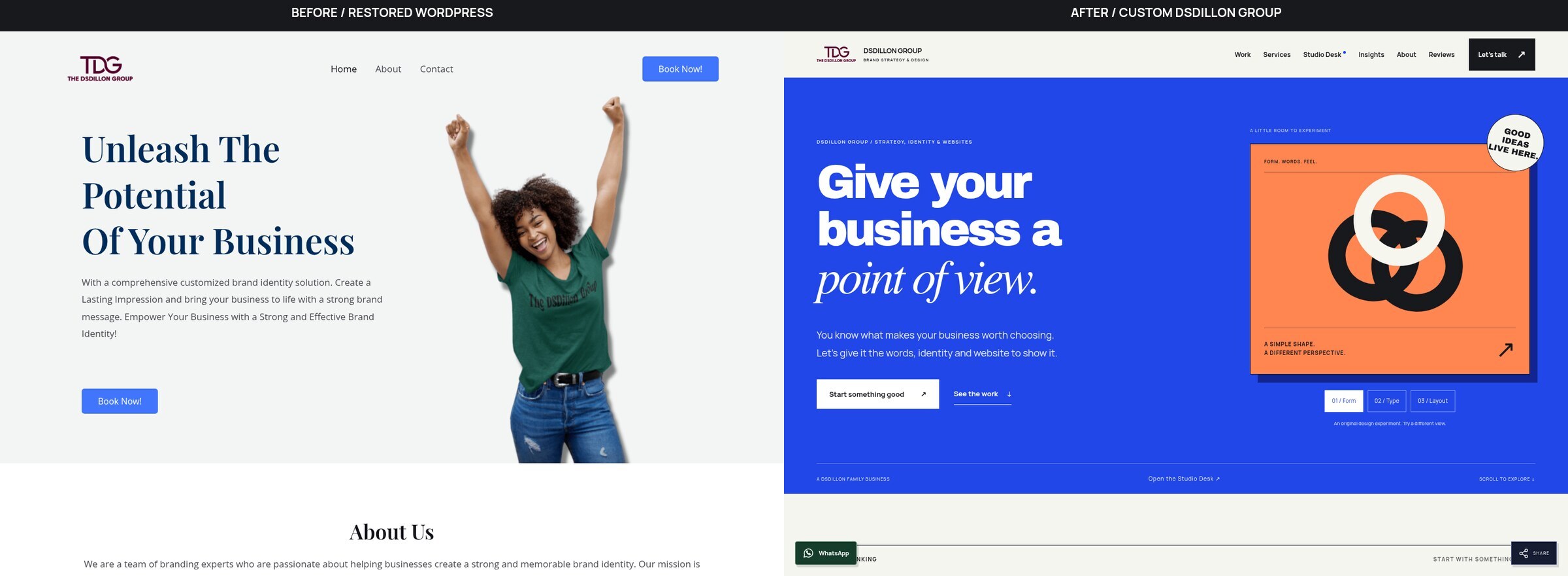
This project concerns dsdillongroup.dsdillon.com. The separate branding website at thedsdillongroup.dsdillon.com had already been completed. The instruction was to give the newly restored property a different design and leave the existing one alone.
The source was the 31 October 2023 backup of dsdillongroup.com. Its WordPress pages, database and media were restored separately before the redesign. Home, About, Contact and Portfolio supplied the original business context. The recovered TDG logo stayed part of the identity.
The original installation and screenshots were retained. File comparisons were used to check that the completed neighbouring branding site stayed unchanged. This created a clear record of which website was being rebuilt and which one was being protected.
A more direct introduction
The original website described a broad branding offer, including logos, company profiles, mission and vision statements, brand values and websites. We kept that commercial focus and organised it into six services: brand strategy, logo and identity, words and company profiles, brand refreshes, guidelines and launch assets, and custom websites.
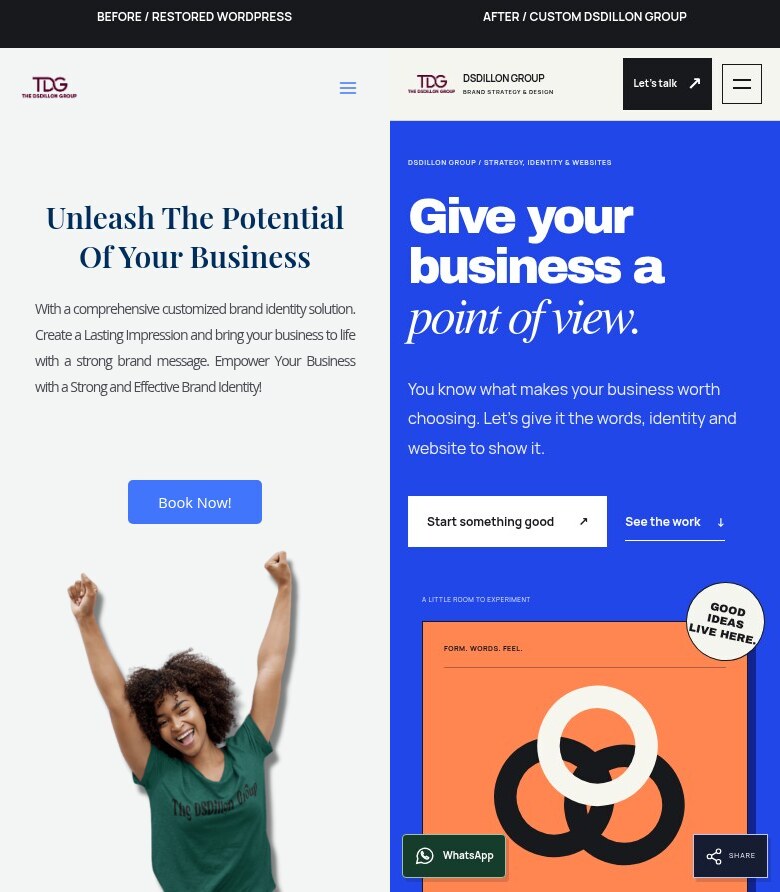
The new homepage opens with 'Give your business a point of view.' It is followed by a plain explanation of the work and a route into either the projects or a conversation. The new copy asks for the business, the customer and the issue to solve. It leaves room for a proper scope before making commitments.
Researching the questions behind the brief
The content research looked at public search results and autocomplete suggestions around branding budgets, identity packages, company profiles, mission statements, logo files and website briefs. It also reviewed service scopes from named providers and primary guidance from Google, Adobe, W3C and the USPTO.
Those questions became eight practical insights. They cover what goes into a company profile, how to prepare a budget, what files a designer should hand over, how to write useful business foundations and what to prepare for a website project. The pages link to relevant sources where external requirements are discussed.
The research was qualitative. Search suggestions helped identify useful language and questions; they did not provide verified monthly search volumes. Claims about later rankings or new customers will require their own evidence.
A visual direction with its own character
Cobalt blue, orange, warm grey and near-black give this website a distinct appearance. Oversized type makes the opening statement, while the original TDG mark remains in the header. A poster on the homepage lets visitors switch between a shape composition, a type treatment and a grid arrangement.
The project wall uses real captures of Wage Master, DSDillon Marketing and Natae Hair & Beauty. Visitors can filter the work, open a larger preview and follow it to a project page. Each is identified as DSDillon family work, with a link to the fuller case study.
Movement is concentrated in the poster and a few small interactions. Visitors can pause it, and reduced-motion settings are respected. The main content stays readable and the page controls remain usable on a phone.
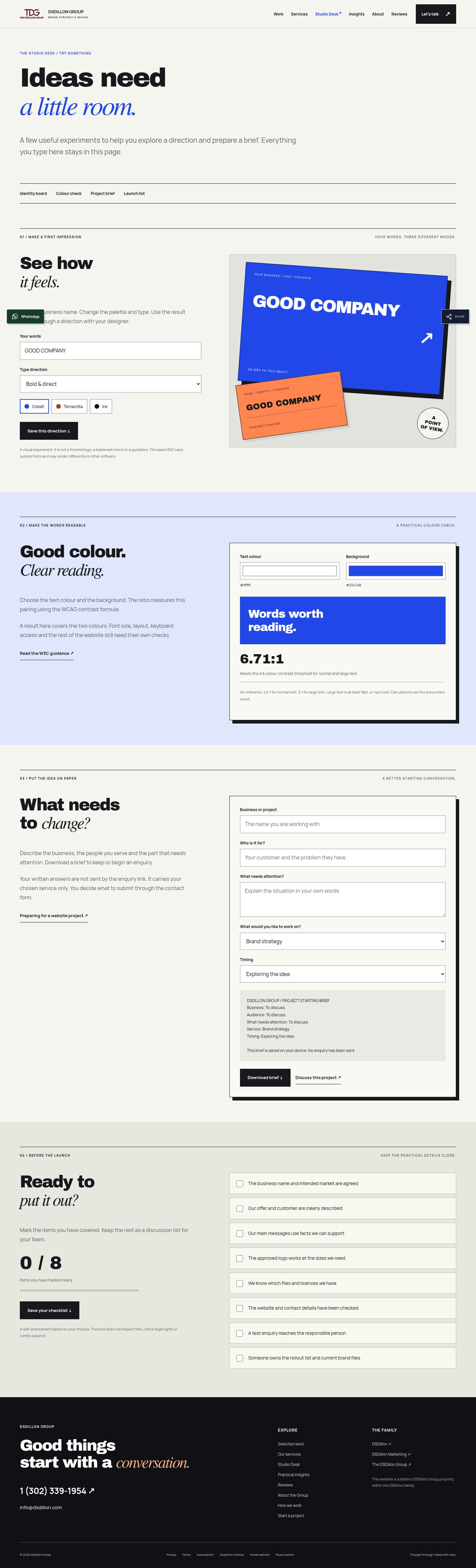
The Studio Desk gives visitors something useful to try
The identity board combines the visitor's words with three colour palettes and three type directions. It updates a poster and business-card composition and can save a simple visual direction as an SVG. The page explains that this is an experiment to discuss, with no claim that it produces a finished or legally cleared identity.
A colour checker calculates the contrast between a chosen text colour and background. It states what the ratio covers and explains that the rest of the design still needs checking. Black against white was tested at 21.00:1.
The brief builder and eight-point launch checklist help visitors prepare for a project conversation. Both create downloadable text files. Written inputs stay in the browser; the enquiry link passes the selected service only. The visitor chooses what to send through the contact form.
The review history stayed part of the website
The saved DSDillon family collection contains 64 Google reviews and 25 Facebook recommendations. All 89 entries were carried into the new site with their original names, comments, dates and source links. The archive date is shown so readers can understand what the numbers represent.
Longer comments open with a four-line preview and a Read more control. Visitors can search the collection, filter by platform, change the order and load additional entries. The homepage carries three featured reviews with a link to the full collection. Rating-only entries remain included.
A clear way to begin the project
The contact page uses 1 (302) 339-1954 and info@dsdillon.com. The enquiry begins with the work required, business stage, timing, budget range and a project description. Contact details and a review step follow. The budget ranges are labelled as discussion points, not advertised package prices.
The server checks the input, request origin and form token. Accepted submissions are saved outside the public website and receive a reference. Testing covered required fields, service preselection, accepted storage, the visitor confirmation, repeat submissions and rejection of an invalid token.
A compact WhatsApp control stays visible. Sharing and back-to-top controls provide shortcuts on longer pages. The installed web-app version also has an offline notice, with enquiry and account requests kept out of its cache.
A separate custom build and its own reporting
The public site now uses generated HTML, custom CSS and JavaScript, with a small PHP layer for enquiries and first-party reporting. Its 29 published pages include six services, eight insights, project pages, reviews and the Studio Desk. WordPress remains preserved privately as the recovery record.
Page titles, descriptions, canonical addresses, structured information and a sitemap are generated consistently. The former Portfolio address redirects to Work, and 192 recovered image files remain available at their earlier upload paths. The copy is present in the delivered HTML.
This property has its own first-party reporting profile. Optional measurement records page and contact activity after visitor permission, using cookies restricted to this site. Written project information stays out of those events. Test activity has its own source label so it can be distinguished from customer visits.
What was checked at publication
The public browser checks covered all 29 pages at desktop and mobile widths, with additional tablet and small-phone checks for key pages. All 68 page checks passed. The interactive poster, project previews, filters, Studio Desk downloads, review controls, navigation and sharing were tested as well.
Before-and-after images use matched desktop and mobile viewports. The original files, database, screenshots and new source remain on the owner's server. A comparison of the 257 pre-existing files at the separate thedsdillongroup.dsdillon.com website found no changes.
This case study records the recovery, design and working features delivered. The next evidence will come from how people find and use the site, the enquiries they send and the business follow-up. Traffic growth, rankings and revenue have not been claimed as launch results.
See the work in its current form
The screenshot records the public website at the time this case study was prepared. Because websites, products, programs and promotions can change, the live destination is the best place to review the current experience.
Need a website built around a commercial problem?
DSDillon designs websites around customer needs, business credibility, search visibility and measurable conversion paths.