
One secure system for connected business operations.
DSDillon designed and built a secure internal operations platform to bring important business information, workflows and decision support into a more coordinated experience. The system connects several areas of the business without turning sensitive records or administrative tools into public-facing services. This case study covers the business problem, design principles and public capabilities. The platform name, access location, internal routes, system topology and security-sensitive implementation details are omitted.
DSDillon
Sector: Business systems, operational reporting and workflow management
Market: Internal business operations
Primary search theme: business operations platform development
Availability: Internal use only. Access details are not published.
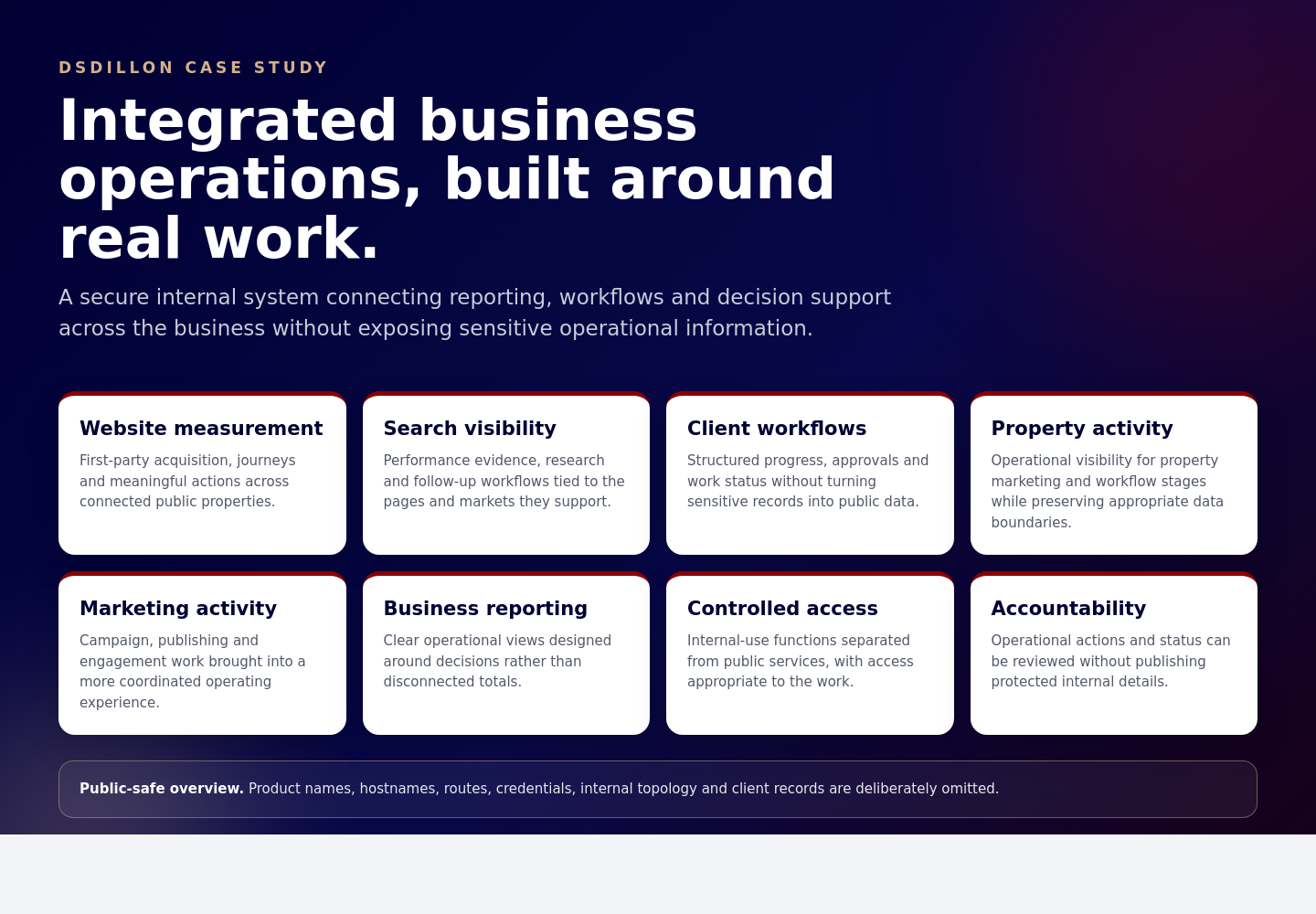
The challenge: important business information was spread across specialist systems
DSDillon works across websites, client delivery, search visibility, property activity, marketing, communications and internal administration. Each area can require its own specialist tools, records and controls. The key requirement is making the right information available when a business decision needs to be made.
The project therefore focused on coordination rather than replacing every specialist system. DSDillon designed an internal platform that can surface relevant information, guide users toward the correct workflow and reduce the need to jump between disconnected reporting experiences.
The public version of this case study deliberately stops at that business level. Names, access locations, internal routes, infrastructure details and security-sensitive implementation information are not published.
A shared operating experience without flattening every workflow
The platform brings together several areas of operational work while allowing specialist systems to keep the rules and data boundaries they need. Website measurement, search information, client work, property activity, communications and administrative functions can be approached through a consistent internal experience.
The design principle is simple: a unified experience should make work easier without pretending every task is the same. A reporting view, an approval workflow and a sensitive client record have different requirements, so the system preserves those distinctions rather than forcing them into one generic screen.
This allows the platform to function as a practical business workspace instead of becoming another layer of duplicated data.
First-party measurement supports better decisions
DSDillon's internal reporting can bring together permitted first-party website activity across connected public properties. That makes it possible to review acquisition, visitor journeys and meaningful actions without relying on pageview totals alone.
Property-specific reporting keeps individual websites distinct while still allowing broader portfolio-level analysis. Public website activity is separated from internal application use so staff activity is not mistaken for customer behaviour.
The result is a measurement foundation designed around actual business questions: where people arrive, what they explore, which actions they take and where attention may be needed next.
Search information is connected to follow-up work
Search performance can be reviewed alongside the pages, queries and business areas it relates to. This helps turn search data into a working process rather than leaving it isolated in a reporting tool.
The wider workflow supports research, visibility review, content decisions and follow-up actions while keeping measurement separate from recommendations and publication. That distinction matters because an observation, a proposed action and a completed change are not the same thing.
The platform was built to support that chain of evidence without publishing the internal mechanisms used to coordinate it.
Client and property work retain appropriate privacy boundaries
Operational reporting can show the state of client work and property-related activity without making sensitive source records part of a general analytics view. This allows authorized users to understand progress while specialist systems continue to hold the detailed records they are responsible for.
The same approach applies to approvals and follow-up. The platform can present the information needed for a decision without copying every document, message or personal record into a central dashboard.
That separation reduces unnecessary exposure and keeps the public website completely outside the internal operating workflow.
Security and access were treated as product requirements
The internal platform is not designed for public discovery. Access controls, private caching behaviour and browser security measures are part of the implementation rather than additions applied after the interface was built.
Sensitive functions can enforce their own authorization requirements, and actions that carry greater operational consequence can follow controlled approval paths. The objective is to make the system useful without making access broader than the work requires.
For the same reason, this case study does not provide a login link, platform address, internal navigation map, credentials, identifiers or screenshots containing private records.
Designing an internal system people can actually use
A large internal platform can easily become difficult to navigate. DSDillon therefore uses a consistent visual and navigation language across the internal experience while allowing individual work areas to keep the controls they need.
Responsive layouts, clear hierarchy, readable tables, form controls and status information help the platform remain usable across everyday operational tasks. The goal is not visual novelty; it is helping an authorized user understand what they are looking at and what they can do next.
That usability work is part of the development effort just as much as the integrations and reporting behind the interface.
What this case study verifies
The project verifies that DSDillon has built and operates an internal business platform connecting reporting, search-related intelligence, client and property workflows, communications and administrative functions within a controlled-access environment.
This public case study summarizes the business problem and development approach. Private product names, hosts, routes, system topology, account details and sensitive operational records are omitted.
This is an implementation case study. It does not assign invented revenue, ranking or efficiency gains to the platform. Business outcomes require their own measured evidence over time.
Why the platform is not linked publicly
This system is used internally and is not offered as a public application. The case study documents the work without publishing access locations, internal routes, client records or security-sensitive details.
The public illustration and implementation record provide evidence of the work without exposing protected operational details.
Need a business system built around an operational problem?
DSDillon designs connected business systems around operational visibility, controlled access, measurable activity and clear responsibility between specialist tools.