
Designing a nonprofit website for a mission that spans housing, sustainability, workforce and community development.
Neighborhoods for a Sustainable Future operates across a broad mission: affordable housing, sustainability, community development and emerging green-jobs pathways. The website had to communicate that scope without reducing the organization to a single program. The live site presents N4SF’s sustainable-development positioning, service reach across New York City, partnership activity, office locations, leadership information, educational content and donation pathways in one public-facing digital property.
Neighborhoods for a Sustainable Future (N4SF)
Sector: Nonprofit and sustainable community development
Market: New York City and New Jersey
Primary search theme: nonprofit website development New York
Live website: https://n4sf.org
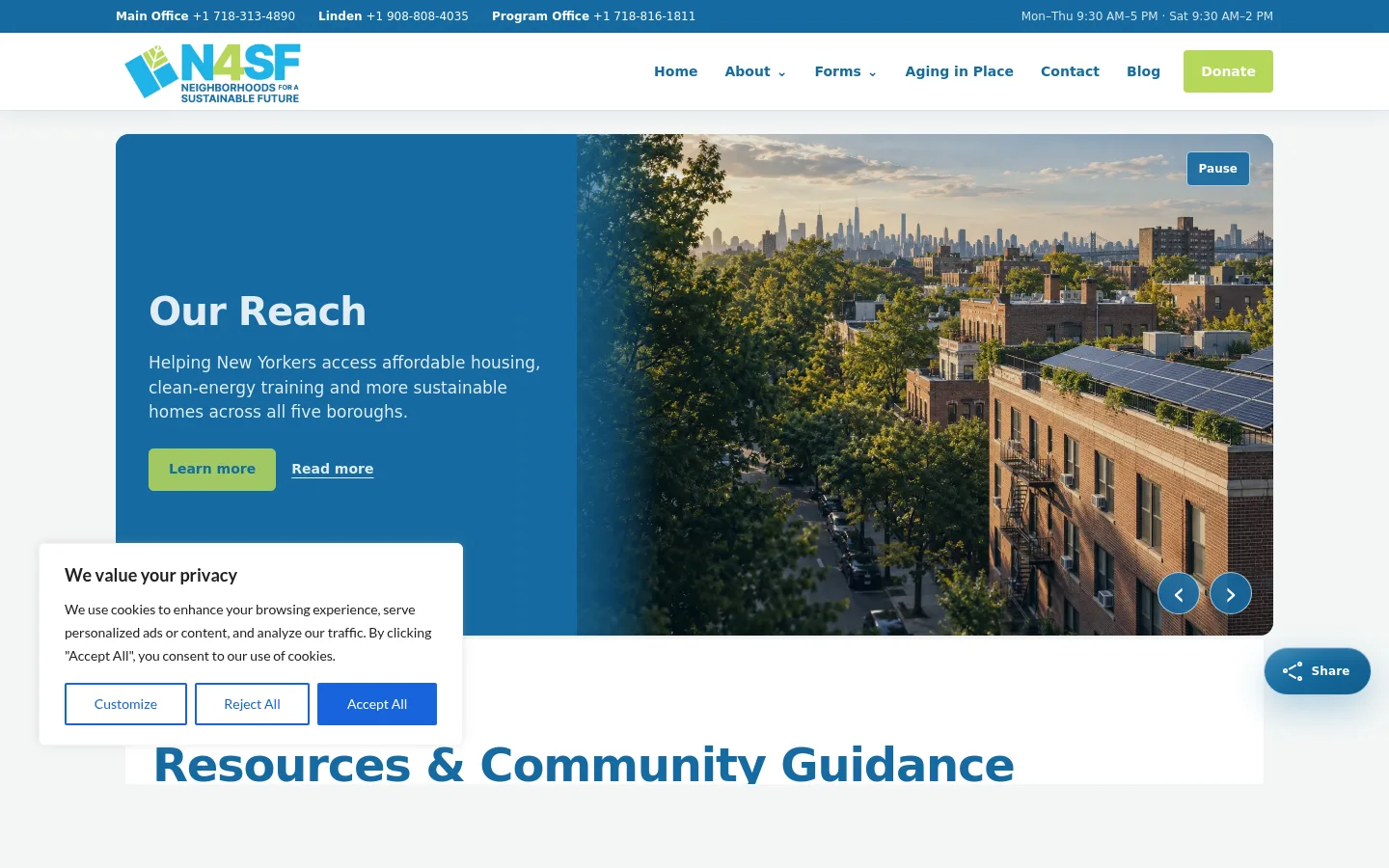
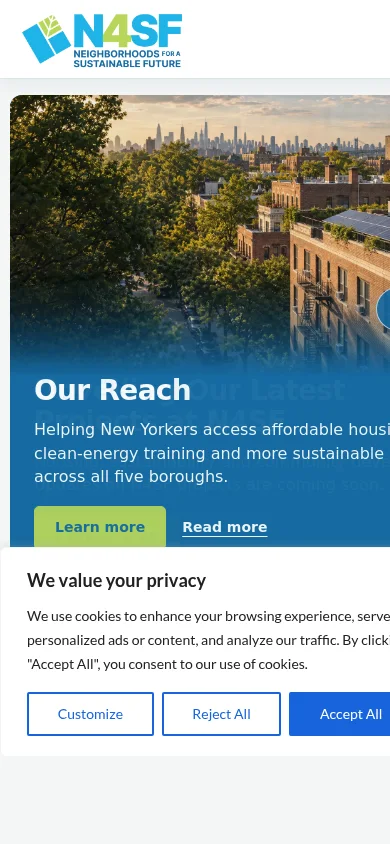
A nonprofit website has to explain mission and action at the same time
N4SF describes itself as having transitioned from a traditional community development corporation to a Sustainable Development Corporation. That positioning immediately creates a communication challenge. Sustainability is a broad term, while the organization’s work also touches affordable housing, community development and workforce opportunity. The website therefore needs to help a visitor understand both the larger mission and the practical areas in which the organization works.
The live homepage addresses that by stating the organization’s reach and connecting sustainability to concrete community outcomes. It says N4SF serves residents across all five boroughs of New York City, with attention to disadvantaged communities and priority populations, and references a partnership with 3Q Innovation to connect residents with emerging green-jobs pathways.
That content gives the website a stronger function than a mission statement alone. It tells a donor, partner, resident or prospective participant what kind of organization N4SF is and where its work is intended to have impact.
Designing around multiple audiences
A nonprofit website rarely serves one audience. N4SF may be visited by residents looking for programs, people interested in affordable housing or sustainability, potential partners, volunteers, donors, board or advisory stakeholders and organizations trying to understand its geographic reach. A useful information architecture has to let those groups recognize themselves without creating a separate website for each.
The public site supports that need through mission content, program and sustainability information, leadership pages, contact details and donation calls to action. The structure allows someone to move from high-level purpose to organizational detail without losing the main public-service orientation.
For DSDillon, this is an example of audience architecture expressed through navigation and content structure. The question is not 'How many menu items should the site have?' The question is 'What does each important audience need to understand before it can trust the organization or take the next step?'
Geographic credibility through visible office information
N4SF publishes multiple physical locations and contact numbers, including a main office in Staten Island, a program office and a Linden, New Jersey homeownership location. That information is operationally important for a community-focused organization because location is part of credibility. Residents need to know where support is available, while partners and funders need to understand that the organization has a real-world presence.
The contact page presents those addresses with direct inquiry information rather than burying them in legal text. The homepage also places location and telephone information near the top of the experience. From a local-search and trust perspective, this is stronger than presenting the nonprofit as an abstract national organization when its work is tied to specific communities.
The site does not need to over-optimize those addresses with repetitive location keywords. The factual presence itself supplies useful geographic context to both users and search systems.
Making leadership and advisory relationships visible
The 'Who We Are' page publishes organizational leadership and research or advisory partners. That transparency is especially valuable for a nonprofit because the visitor may be evaluating governance, expertise and legitimacy before deciding to donate, collaborate or participate.
The page identifies members and officers and then separates research and advisory partners into their own section. This creates an institutional layer of the website that is different from promotional content. It helps answer the question 'Who is behind this organization?' with names and roles rather than broad claims about experience.
For DSDillon, the case demonstrates that a nonprofit website should not make the visitor infer organizational substance from design alone. Good visual presentation helps, but public leadership and partnership information are stronger credibility signals because they can be independently understood and checked.
Content strategy around sustainable development and housing
N4SF publishes educational material around sustainability, green housing and related development topics. The homepage highlights articles discussing sustainable building materials, tourism and greener development. This type of content gives the organization room to explain the issues surrounding its mission rather than limiting the website to organizational announcements.
From an SEO standpoint, that can support topical relevance when the content remains closely connected to the organization’s real work. Search demand around sustainable housing, green jobs, community development and affordability is broad, so the website benefits when articles answer a defined question and connect back to N4SF’s programs or expertise.
The important quality standard is accuracy. Sustainability content can easily become generic. A strong nonprofit website should distinguish sourced public information, organizational positions and actual program activity.
Donation and support pathways
The live site includes a direct 'Donate' pathway and language inviting visitors to support sustainable housing and better communities. That call to action is important because a nonprofit website should allow mission alignment to become support without requiring a visitor to search for a hidden donation page.
The surrounding content gives context before the ask. A visitor can understand the organization’s purpose and reach before being asked to contribute. That is a better user experience than placing a donation button on a site that has not yet explained the work.
For organizations considering nonprofit web design, the broader lesson is that fundraising conversion should be integrated with credibility. Donation technology is only one part of the task; the website also has to make the case for why the organization exists, who it serves and who is accountable for the work.
What was delivered
N4SF has a live organizational website presenting its sustainable-development mission, geographic reach, multiple office locations, leadership and advisory information, content resources and donation pathways.
The website also provides a current framework for communicating N4SF’s partnership with 3Q Innovation and its green-jobs emphasis across New York City. That gives the organization a digital property capable of representing new program priorities without abandoning the affordable-housing and community-development context already associated with the organization.
The project is therefore a useful portfolio example for nonprofit website development because the challenge is structural: making a broad mission understandable, credible and actionable for several audiences at once.
What this project demonstrates about DSDillon website development
N4SF shows DSDillon’s work on a website that carries public-interest information across several programs and audiences. The project requires mission hierarchy, geographic detail, organizational transparency, content publishing and conversion paths for support.
It also shows why nonprofit web development benefits from clear public facts, program information and participation paths. The website can communicate the organization’s mission while keeping program outcomes tied to the organization’s own reporting.
For nonprofits comparing website developers, this project illustrates the value of designing around stakeholder questions: What does the organization do? Who does it serve? Where does it operate? Who leads it? What does it know? How can someone participate, contact the organization or support the mission?
Designing for public trust and participation
N4SF serves several public-interest audiences, so the site supports understanding and trust before asking for any one action. A resident may need program information, a partner may need organizational context, a donor may want to understand governance, and a volunteer may be looking for contact details. Each of those journeys depends on confidence in the organization.
That is why leadership, addresses, program language and mission context matter as much as a donation button. In nonprofit website development, the website itself becomes part of the organization’s public record. Inconsistent contact information or vague program descriptions can create more friction than an imperfect visual detail.
The N4SF project therefore illustrates a different kind of conversion design: build enough institutional clarity that the appropriate next action, whether contact, participation, partnership or donation, feels supported by what the visitor has already learned.
Project record
This record reflects N4SF.org as published in September 2026, including its stated geographic reach, sustainable-development positioning, office locations, leadership information, partnership references and donation pathways. DSDillon completed the website-development work shown here.
Funding, donation, enrollment, job-placement and search-performance results can be added when the corresponding organizational or analytics data is available for publication.
This project record covers the website, its information architecture and its public participation paths.
Search visibility without reducing the mission to keywords
N4SF’s subject matter spans terms that are individually broad: sustainable development, affordable housing, green jobs, community development and sustainability. The SEO challenge is to make those themes discoverable without turning the site into disconnected keyword pages. The more credible approach is to map each subject to real organizational work, programs, partnerships or educational resources.
That is also consistent with modern search guidance. Useful pages connect search topics to the organization’s actual purpose, expertise and work. For N4SF, the strongest future content is therefore content that can connect a community question to the organization’s actual mission, geographic reach or program activity.
The case study demonstrates that nonprofit SEO is not separate from institutional clarity. When the organization explains who it serves, where it works and what its programs address, it creates both better public communication and stronger search context.
See the work in its current form
The screenshot records the public website at the time this case study was prepared. Because websites, products, programs and promotions can change, the live destination is the best place to review the current experience.
Open Neighborhoods for a Sustainable Future (N4SF) in a new tab
Need a website built around a commercial problem?
DSDillon designs websites around customer needs, business credibility, search visibility and measurable conversion paths.