
Building a hairstylist website where every hairstyle becomes its own searchable booking journey.
Natae Hair & Beauty needed more than a polished salon homepage. The business is appointment-based, serves women, men and children 2+, and offers a broad menu of braids, twists, locs, installs, kids styles and men’s natural hairstyles. DSDillon turned that service menu into a 41-URL web experience with dedicated hairstyle pages, collection hubs, a Style Finder, gallery, hair-model pathway, local-search pages, WhatsApp booking handoff, structured search data and first-party journey analytics synchronized with DSDillon’s first-party reporting system.
Natae Hair & Beauty
Sector: Hair styling and beauty services
Market: Gasparillo, South Trinidad, Trinidad & Tobago
Primary search theme: hairstylist website design Trinidad
Live website: https://natae.dsdillon.com
The business problem: a new hairstylist needs more than a digital brochure
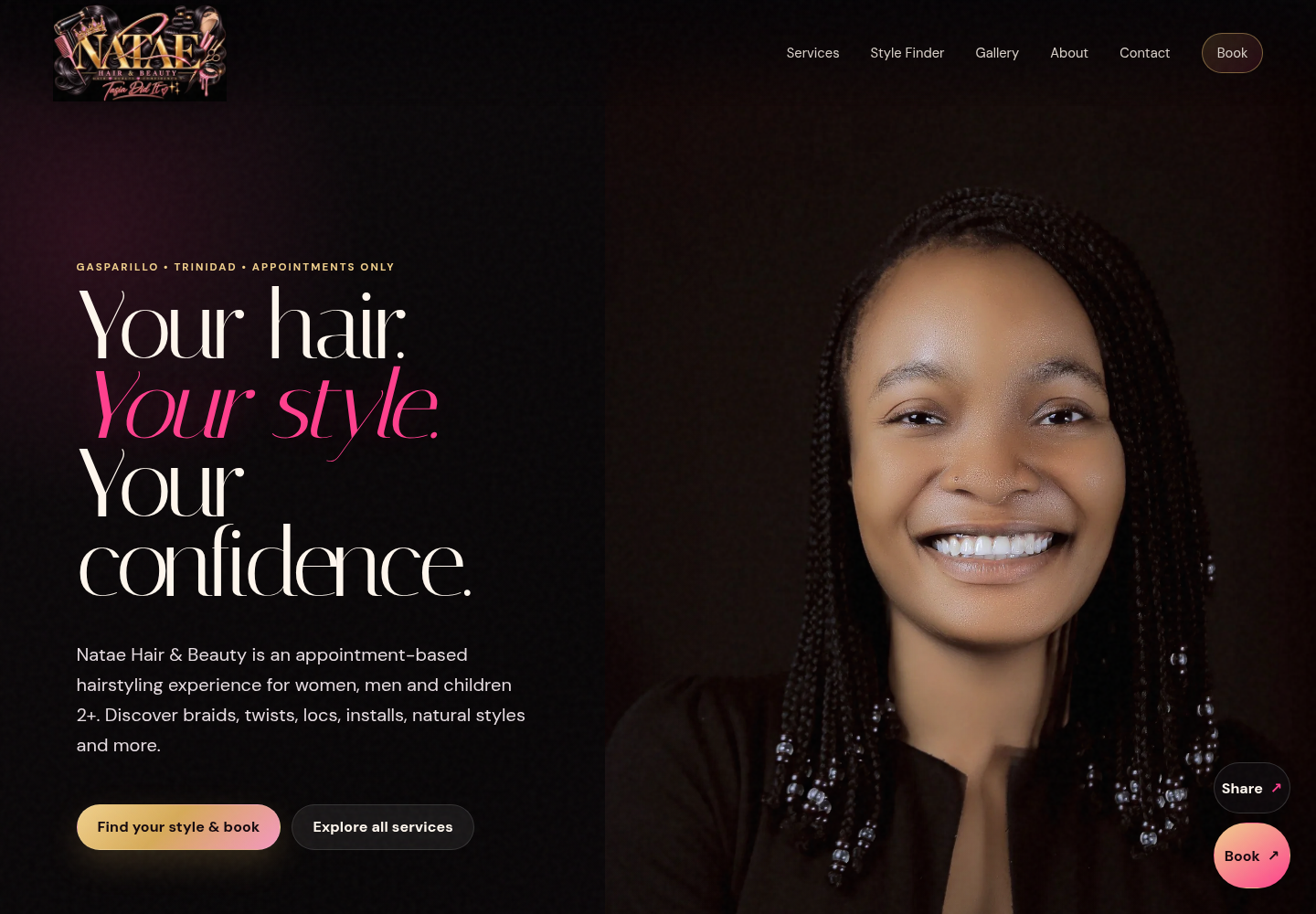
Natae Hair & Beauty is an appointment-based hairstyling business in Gasparillo, Trinidad. The service menu covers multiple categories and audiences: women, men and children age two and over, with braids, cornrows, twists, locs, installs, kids styles and natural styles for men. A conventional salon website with one services page would make that range visible, but it would not help a prospective client quickly identify the exact style they want or give search systems enough context to distinguish one service from another.
The project therefore began with a different assumption: each material hairstyle is a customer journey. Someone looking for knotless boho braids is not searching for the same thing as someone looking for a loc retwist, wig reinstall, Fulani braids or a kid-friendly hairstylist. The website had to respect those differences while still feeling like one coherent Natae Hair & Beauty brand.
DSDillon’s role was to turn a starting-stage beauty business into a credible digital property with room to grow. That required visual identity, search architecture, mobile usability, service education, local relevance, appointment pathways and measurement to work as one system rather than as separate add-ons.
A website-inside-a-website structure for hairstyle collections
The information architecture is built around collection hubs that behave like focused mini-sites inside the broader Natae experience. The Braid Atelier groups braid and cornrow services, The Twist Room covers twist styles, The Loc Studio organizes loc services, The Install Suite handles sew-ins, quick weaves and wig work, The Little Style Club gives children’s services a distinct home, and the Men’s Chair separates men’s styling from the rest of the catalogue.
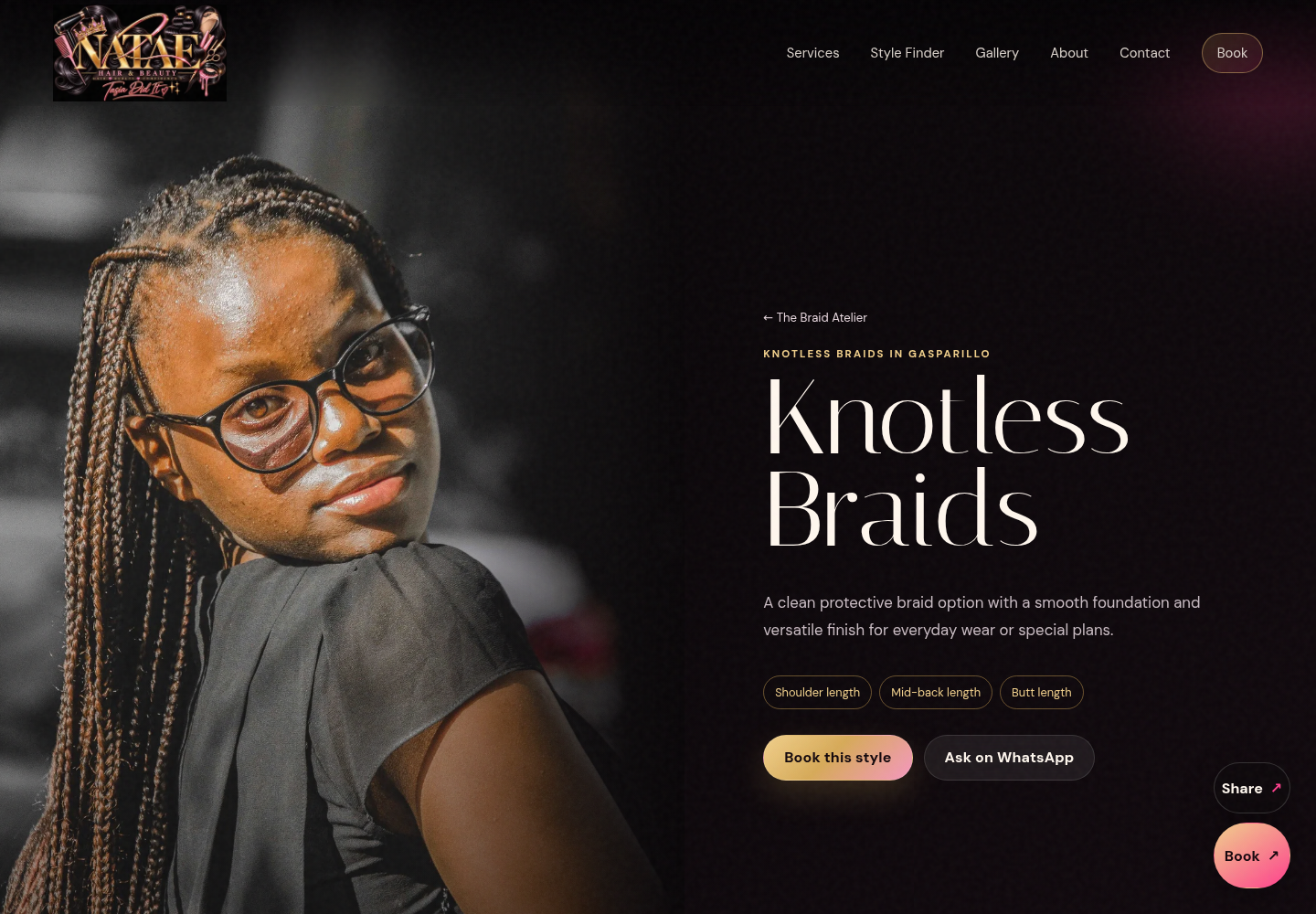
Each collection has its own visual treatment, supporting copy, internal links and service cards. From there, visitors can open the individual hairstyle they actually intend to book. This avoids forcing a large, mixed service list onto one page and gives every collection enough space to explain its own purpose.
The structure also supports future expansion. New braid, twist, loc or install services can be added to the relevant collection without redesigning the whole website. That matters for a hairstylist because the service menu changes with training, demand, trends and the styles the business wants to promote.
Forty-one crawlable URLs built around real hairstyle and local-search intent
At publication, the Natae sitemap contains 41 URLs. The structure includes the homepage, core information pages, six service collections, individual hairstyle pages, booking and Style Finder tools, plus local-intent pages such as 'braider near me,' 'hairdresser near me' and house-call hairdresser information. The purpose is not to inflate page count. Each route exists because it represents a materially different service, customer question or conversion step.
Individual services include knotless boho braids, knotless braids, Fulani braids, feed-ins, cornrows, box plaits, Senegalese twists, rope twists, two-strand twists, textured locs, soft locs, loc retwists, half-up half-down sew-ins, quick weaves, wig installs, wig reinstalls, kids styles, braid styles for kids, kid-friendly hairstyling and natural styles for men.
This page-level separation creates stronger relevance for high-intent searches than a generic salon services paragraph. A person searching for a specific hairstyle can land on a page whose title, heading, image, copy, FAQs and booking action all refer to that exact service.
Visual accuracy is part of conversion quality in a hairstyle website
Hair is an unusually visual service category. A page can have technically correct copy and still lose trust if the photograph does not represent the hairstyle named in the heading. During the build, DSDillon treated image-service matching as a functional requirement rather than decoration. The hairstyle shown on a knotless, Fulani, feed-in, loc, twist, kids or men’s page has to make sense beside the service being described.
The production image library was therefore reorganized around descriptive, search-readable filenames such as knotless-boho-braids-gasparillo-trinidad.webp, fulani-braids-gasparillo-trinidad.webp and senegalese-twists-gasparillo-trinidad.webp. Alternative text follows the same principle: describe the visible hairstyle and local service context without stuffing unrelated keywords.
That discipline improves both usability and search clarity. A prospective client should not have to read a paragraph to discover that the picture conflicts with the service title. In a beauty portfolio, the image is part of the explanation.
Local SEO and voice-search content for Gasparillo and South Trinidad
Natae Hair & Beauty is locally anchored in Gasparillo, so the website uses that geography where it helps a customer decide whether the business is relevant. Service pages reference Gasparillo and South Trinidad naturally, while local-intent pages address searches such as 'braider near me' and 'hairdresser near me.' The site also gives house-call searches a truthful route that explains that requests must be discussed and confirmed rather than implying a guaranteed mobile service.
Voice-search behavior is addressed through question-based content. Individual service pages answer conversational queries such as who does a particular hairstyle near Gasparillo, whether the style can be booked in South Trinidad, and how to request the appointment. Those answers also make the site’s service and location relationships clear.
The broader SEO strategy remains transactional. The site is designed to capture people who are researching a style and people who are already trying to find someone to do it. Those two intents meet on the same service architecture rather than being split into disconnected marketing pages.
The Style Finder turns browsing into a guided customer journey
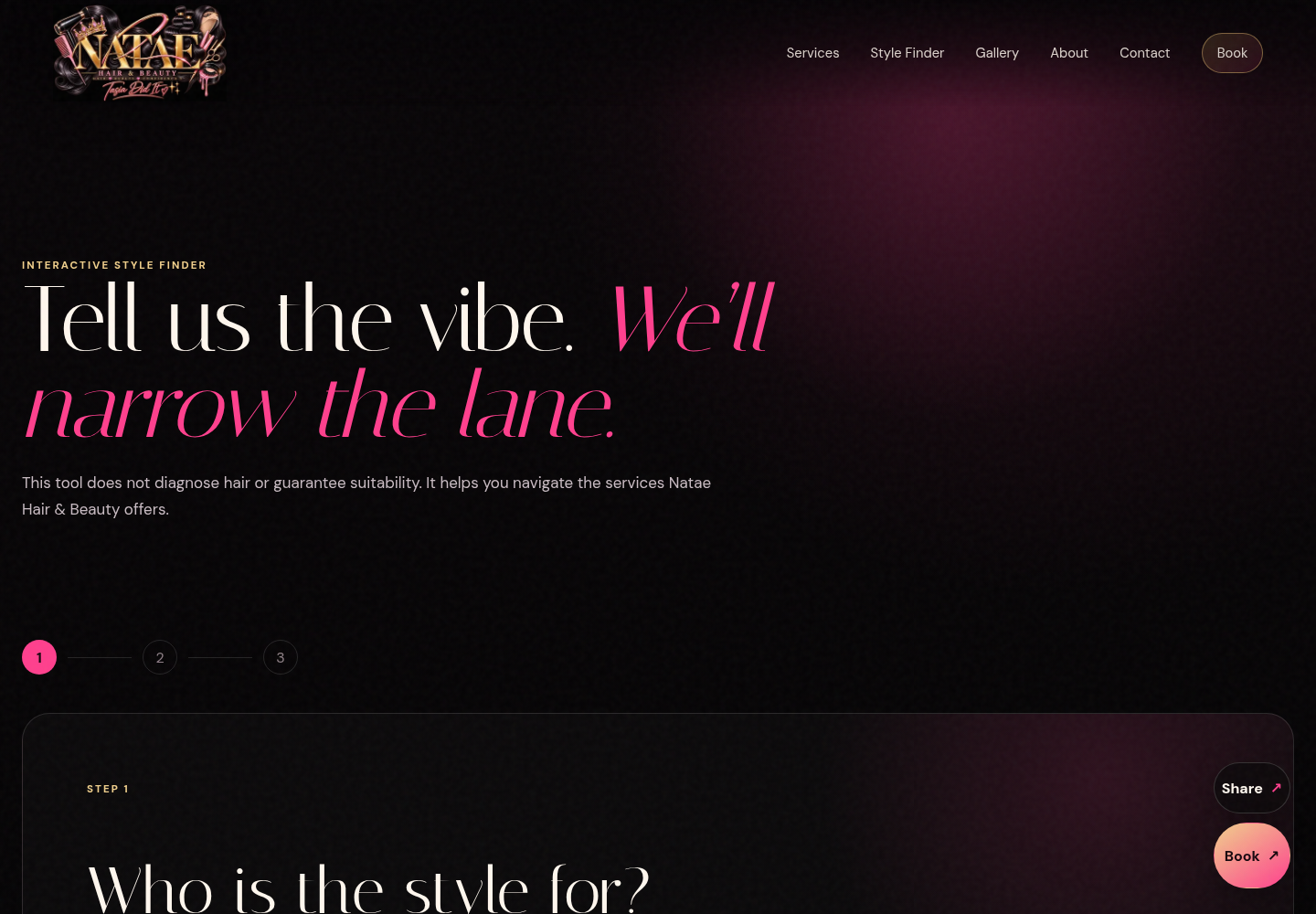
A large hairstyle menu can create choice overload, especially for a customer who knows the look or outcome they want but not the service name. Natae’s Style Finder provides an interactive route through that problem. It asks who the style is for, the styling direction and what matters most, then points the visitor toward the relevant collection.
For women, men and children, the tool changes the browsing task from 'read every service' to 'answer a few practical questions.' A visitor interested in braids is directed toward the Braid Atelier; a child’s request can route toward The Little Style Club; a man looking for natural styling can move toward the men’s service path.
The Style Finder is also measurable. DSDillon’s first-party analytics records the interaction steps and completion event without recording sensitive free-text booking information. This allows the business to understand whether visitors are using the guided journey and which service direction is selected.
Booking architecture built around appointments and WhatsApp
The website reflects the way the business actually accepts work: appointments only. Visitors can choose a service, specify a preferred variation or length, select a preferred date and prepare a booking request. The final action opens WhatsApp with the request formatted for the client to send, while the page makes clear that an appointment is not confirmed until Natae Hair & Beauty responds.
Telephone and WhatsApp are deliberately separated because they serve different actions. The call number is presented for direct calls, while the dedicated WhatsApp number powers message-based booking and service questions. That sounds minor, but contact accuracy is a core conversion requirement. A polished page with the wrong destination is worse than a plain page with the correct one.
The booking handoff also protects the role of the stylist. The website can structure the request, but availability, service-specific requirements and final confirmation remain with Natae Hair & Beauty rather than being represented as automatically approved by the site.
First-party analytics connected to DSDillon reporting
Natae is registered as its own public analytics surface in DSDillon’s first-party measurement system. The production website records page views, acquisition and campaign context, internal navigation, engagement time, scroll depth, device and browser categories, performance signals, call actions, WhatsApp actions, booking intent, outbound actions and Style Finder interactions. The data feeds DSDillon’s first-party reporting system.
The implementation is designed around customer journeys rather than pageview totals alone. DSDillon can distinguish a person opening the homepage from someone moving into a braid collection, selecting a specific service, using the Style Finder or beginning a booking path. Share activity can also create first-party lineage so a shared Natae page is not treated as unrelated traffic when the tracked link is opened later.
The system deliberately avoids copying the customer’s booking-form field values into analytics. Names, notes, preferred dates and hairstyle details typed into the form are not used as analytics payloads. The business can measure the journey and conversion action without treating the customer’s message content as behavioural telemetry.
Mobile controls support the way local hair clients actually browse
A local hairstylist website is likely to be discovered and used heavily from a phone. The mobile experience therefore includes a dedicated navigation menu and a persistent quick-action dock for calling, using the Style Finder, booking and opening WhatsApp. The layout separates imagery from copy so text does not compete with the hairstyle being presented.
Global Share and Back to Top controls were added without covering the mobile action dock. Share allows a visitor to send the exact hairstyle or service page rather than sending someone a generic homepage. Back to Top reduces friction on long service and case-rich pages where the user may want to return to navigation after reading deeply.
These are small interface details with commercial consequences. A hairstylist’s customer may be comparing looks, sending a page to a friend, returning to another service or moving directly into WhatsApp. The mobile interface is organized around those real actions.
Technical search foundations for Google, voice and AI discovery
The site publishes canonical URLs, a sitemap, robots directives and an llms.txt file. Service and local-business structured data describes the business and its services, while descriptive titles and headings state what each style is and where it is offered.
Search-readiness also extends into internal linking. Collection hubs link to individual services; service pages link back to their collection and related styles; local-search pages move visitors toward exact services; and the booking path preserves the selected hairstyle where possible. This creates a connected service structure with clear paths between collections, services, local pages and booking.
No technical markup can guarantee rankings, voice-assistant inclusion or AI citations. The defensible objective is to give those systems clear, crawlable, consistent information that matches the public business and the questions customers are likely to ask.
What was delivered
The delivered website includes 41 sitemap URLs, distinct hairstyle and collection pages, working booking and contact pathways, an interactive Style Finder, local-search pages, structured search data, mobile controls and first-party analytics connectivity.
Production testing also verified that the Natae analytics surface writes page and interaction events into DSDillon’s central web-analytics infrastructure. Test journeys recorded homepage and Style Finder page views, Style Finder selections and a completion conversion, while first-party share creation produced a Natae share record in the central system. Those are system-verification events, not claims about customer behaviour at scale.
That distinction matters. The case study can prove what was built and what the measurement architecture is capable of observing. Longer-term search visibility, enquiries and commercial outcomes should be reported only after enough real customer data exists to support those conclusions.
What this project demonstrates about DSDillon website development
Natae Hair & Beauty demonstrates DSDillon’s ability to build a consumer service website around a large set of specific buying intents without turning the experience into a repetitive directory. Each major service can stand on its own for search and booking while still belonging to an immersive visual brand.
The project also connects website development, local SEO, conversion design and analytics at launch. Those disciplines reinforce each other: the same service architecture that helps a customer find the right hairstyle gives search systems clearer subject matter and gives analytics a more meaningful journey to measure.
For salons, braiders, hairstylists and beauty professionals evaluating a website developer, the practical lesson is that the website should mirror how customers choose. They search by style, compare visual evidence, check location, ask questions, send the look to someone, and then request an appointment. Natae was built around that sequence.
Project record
This case study is based on the Natae Hair & Beauty production website and DSDillon’s own implementation records as reviewed on 16 September 2026. The screenshots were captured directly from the live public site. The 41-URL count comes from the live sitemap at publication time, and the analytics statements refer to the first-party DSDillon system configured for the Natae property.
The project record covers the public website, implementation details and analytics setup. Customer information remains private. Ranking, client, conversion and revenue results can be added when supporting data is available for publication.
The portfolio records the design, search, interaction and measurement work delivered for the project.
See the work in its current form
The screenshot records the public website at the time this case study was prepared. Because websites, products, programs and promotions can change, the live destination is the best place to review the current experience.
Need a website built around a commercial problem?
DSDillon designs websites around customer needs, business credibility, search visibility and measurable conversion paths.