
Building a cleaning service website around reliability, service coverage and the next customer action.
Orbital Sanitation’s website is designed around a service buyer who needs to know what is cleaned, where service is available and how to request help. The live site separates commercial, residential and customized cleaning, highlights deep cleaning and scheduled maintenance, explains service coverage across Trinidad and Tobago, publishes business hours and telephone information, and uses direct request and callback pathways to convert local service demand into inquiries.
Orbital Sanitation
Sector: Commercial and residential cleaning
Market: Trinidad & Tobago
Primary search theme: commercial cleaning website design Trinidad and Tobago
Live website: https://orbitalsanitation.com
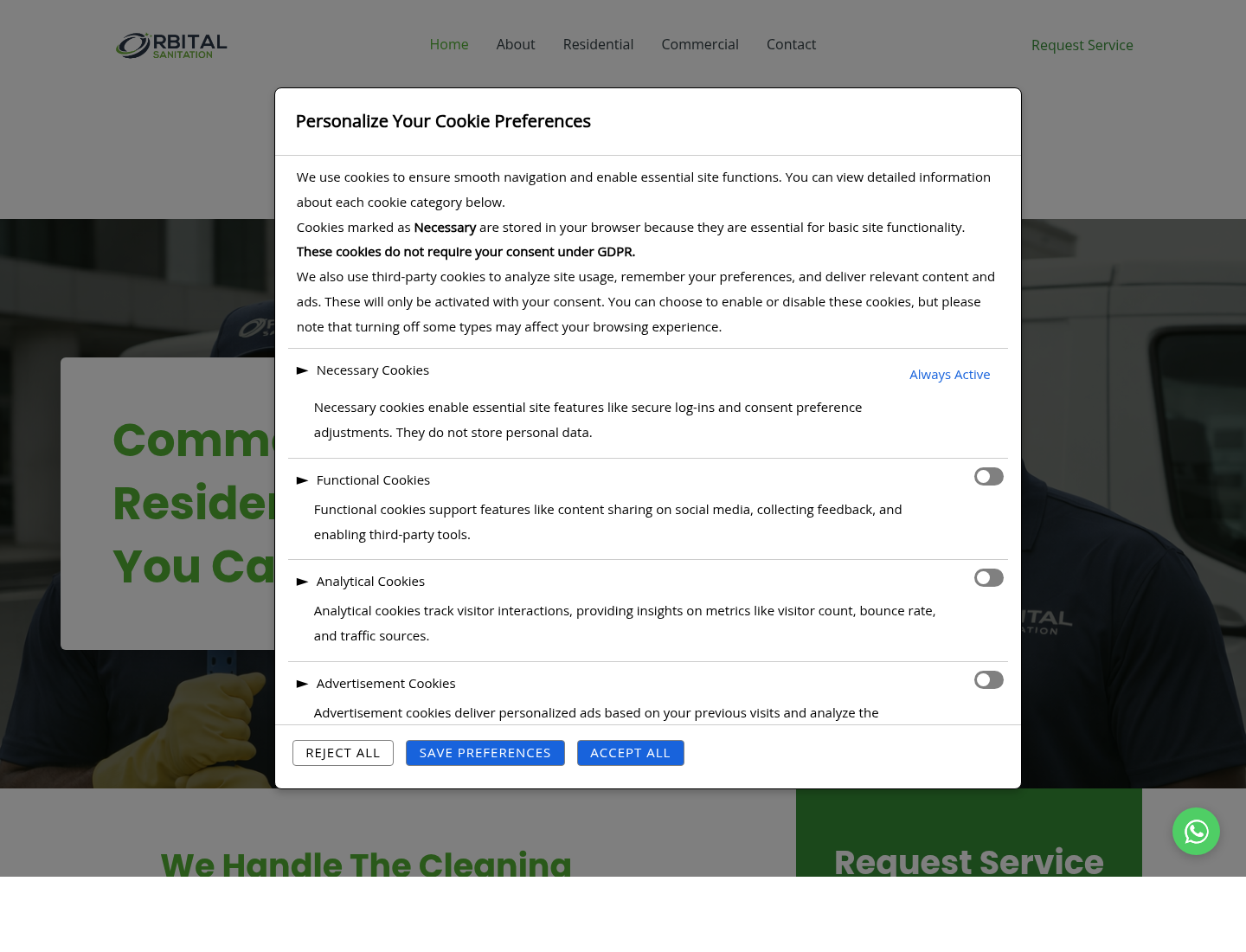
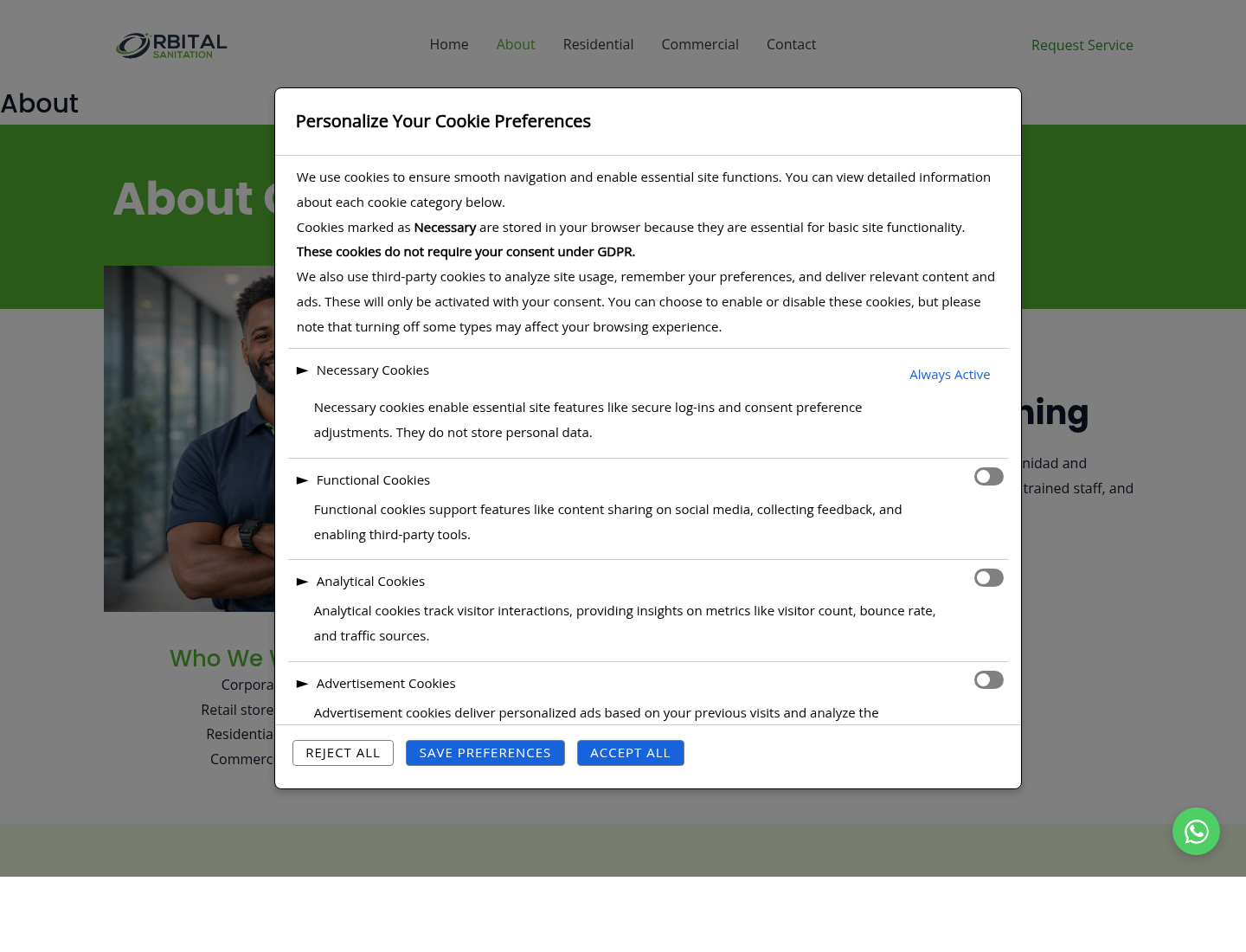
The customer question is operational: can this company clean my space reliably?
Commercial cleaning is a category where website language can become interchangeable very quickly. Almost every provider can say that it is professional, reliable and thorough. A useful cleaning-company website therefore has to support those claims with a clear description of who the service is for, what work is offered, where the company operates and how a prospect can request service.
Orbital Sanitation’s live homepage leads with commercial and residential cleaning and then breaks the offer into commercial cleaning, residential cleaning and customized cleaning. It further identifies move-in and deep cleaning, scheduled maintenance, trained and uniformed staff and consistent service delivery.
That creates a clearer buying context than a generic list of cleaning tasks. A property manager, office operator, retailer or homeowner can quickly determine whether the company appears to serve the type of environment they need cleaned.
Commercial and residential intent are separated but kept under one brand
The site serves both business and household customers. Those audiences can overlap in geography but differ in expectations, scheduling, scope and buying process. The homepage handles this by presenting separate service categories while keeping a shared positioning around consistency and professionally managed sanitation.
The About page adds more detail about who the company works with, including corporate offices, retail stores and plazas, residential properties and commercial facilities. That content helps qualify the inquiry before a form is submitted.
For DSDillon, the information architecture demonstrates how a local service website can support more than one customer segment without diluting the main offer. The site does not need a separate brand for every service type; it needs enough hierarchy for each buyer to recognize the relevant path.
Local service coverage is made explicit
Orbital publishes service coverage across Trinidad and Tobago and names practical regions including Port of Spain, West Trinidad, Central Trinidad and East Trinidad. The homepage further references communities such as Diego Martin, St. James, Woodbrook, Chaguanas, Couva, Freeport, Arima, Trincity and Tunapuna.
That geographic information is useful for customers because it answers one of the first questions in any service inquiry: does the company come to my area? It also provides search engines with factual local context without requiring repetitive location pages for every community.
The key is that service-area content should reflect real operations. A cleaning business gains little from ranking for a location it cannot serve. The website’s regional framing is therefore both a conversion feature and a local-search relevance signal.
Lead generation is integrated into the service content
The homepage repeatedly presents a 'Request Service' action and includes a callback form. The form asks for the visitor’s name, contact number and message, which is appropriate for an early-stage cleaning inquiry where the final scope may depend on property type, size, frequency and required tasks.
The site also publishes a direct telephone number and business hours. That matters for customers who need to know when the company can be reached and do not want to wait for a form response.
From a conversion-design standpoint, the website does not require the visitor to navigate through several informational pages before requesting service. The lead path is visible while the prospect is still reviewing the offer.
Positioning around managed consistency rather than one-time labor
A particularly useful element of the copy is the emphasis on structured service, trained staff, defined cleaning standards and consistent quality control. For a commercial client, the problem is often not finding someone who can clean once; it is maintaining a standard without constant supervision.
The About page explicitly states that the company focuses on consistent results through structured service, trained staff and clear standards. That gives the website a commercial message that is more specific than 'we make spaces clean.' It speaks to the management burden the client wants to reduce.
For DSDillon, this demonstrates outcome-oriented website copy. The service remains cleaning, but the commercial benefit is reliability and reduced need for follow-up.
Local SEO and service-page relevance
The homepage title and main content use phrases that match how buyers naturally describe the service, including commercial cleaning, residential cleaning, sanitation services and Trinidad and Tobago coverage. Those terms are used in context rather than inserted as a separate keyword list.
Google’s current search guidance recommends using words people would use to look for the content in prominent locations such as titles, headings and link text, while still prioritizing helpful people-first pages. A local cleaning site benefits when the page clearly says what the business does and where it operates.
The strongest ongoing SEO opportunities for a company like Orbital are closely tied to real services: commercial office cleaning, deep cleaning, scheduled maintenance and location-specific customer questions. Publishing unrelated cleaning articles simply for volume would be less useful than answering the questions that precede a service request.
What was delivered
The live service website communicates commercial and residential cleaning, structured service positioning, Trinidad and Tobago coverage, direct telephone access, business hours and callback/request pathways.
The public site also gives different customer types a clear path to self-identify before contacting the company. That improves the quality of the website as a sales asset even without attaching an unsupported percentage improvement to it.
The screenshots presented here are direct captures of the live public website and serve as visual evidence of the delivered experience.
What this project demonstrates about DSDillon website development
Orbital Sanitation is a strong example of DSDillon’s local service-business web development approach. The website is built around commercial intent: identify the service, establish the geographic fit, explain the operating standard and make contact easy.
It also demonstrates that SEO and conversion design do not need to be separate projects. The same service-area and service-type clarity that helps a search engine understand the page also helps a customer decide whether to request a quote.
For cleaning companies and other field-service businesses evaluating a website developer, this project shows the importance of building around operational questions instead of generic brand statements. A useful site should help the customer answer 'Do you handle my type of property, in my area, to the standard I need, and how do I get started?'
Mobile conversion for a local service request
Cleaning-service prospects often search while managing an immediate operational need. A facilities manager may be on-site, a tenant may be preparing to move, or a homeowner may be comparing providers from a phone. The website therefore has to communicate service fit quickly on a small screen.
Orbital’s repeated request-service actions, direct telephone number and regional service coverage support that behavior. The prospect does not need to study a complex corporate site before finding a way to contact the business. At the same time, the service descriptions provide enough context to distinguish ongoing commercial cleaning from one-time or residential needs.
This combination is important for lead-generation website design. A mobile CTA is only useful if the visitor already understands what the company does. Orbital pairs the action with service and location information so the contact path is supported by context rather than floating separately from the offer.
Project record
The Orbital Sanitation case study is based on the public website reviewed in September 2026, including the homepage and About page. The statements about commercial and residential cleaning, service regions, cleaning categories, trained staff positioning, business hours and request pathways are drawn from information visible on those pages.
Private customer names, contract values and revenue figures are excluded. Promotional offers can change, so current terms are shown on the live site.
The record shows the website structure, commercial logic and customer pathways.
Service-page expansion should follow real commercial demand
A local cleaning website can expand beyond the homepage when there is a genuine need to explain a service in more detail. Dedicated pages for office cleaning, deep cleaning, move-in cleaning or scheduled commercial maintenance can be useful when the service has distinct search intent, scope and buying questions.
The important point is not to create dozens of near-identical pages for every town. Strong local-service SEO uses geography and service detail where they help a customer make a decision. Orbital already establishes broad coverage and core service categories, creating a foundation for deeper pages only where the business can support them operationally.
This keeps the website aligned with the company rather than with a keyword spreadsheet. The goal is qualified local demand, not a high page count.
Why proof should stay tied to observable service delivery
Cleaning websites often use broad claims such as 'best,' 'number one' or 'guaranteed quality' without explaining how those statements are supported. Orbital's stronger positioning is operational: structured service, trained staff, defined standards and clear coverage. Those claims are easier for a prospective customer to understand and discuss during the quoting process.
For DSDillon, that reinforces a portfolio principle that applies beyond cleaning. The website should sell the outcome the business is actually organized to deliver. In this case, the message is not merely a spotless surface; it is dependable cleaning that reduces the customer's need to supervise the service.
See the work in its current form
The screenshot records the public website at the time this case study was prepared. Because websites, products, programs and promotions can change, the live destination is the best place to review the current experience.
Need a website built around a commercial problem?
DSDillon designs websites around customer needs, business credibility, search visibility and measurable conversion paths.