
A creative home for The DSDillon Group.
The DSDillon Group is the creative branding business within the DSDillon family. We recovered its original website, kept the TDG identity and built a custom site where visitors can explore the work, try visual ideas and prepare a branding enquiry. The project brings together 29 published pages, the interactive Brand Lab, preserved family reviews and its own first-party reporting.
The DSDillon Group
Sector: Brand strategy, visual identity, messaging and custom websites
Market: United States and online branding enquiries
Primary search theme: creative branding website design
Live website: https://thedsdillongroup.dsdillon.com/
The original TDG identity
The recovered TDG mark remains at the centre of The Group's website. The DSDillon Group is the creative branding business within the DSDillon family.
Project contact: 1 (302) 339-1954 · info@dsdillon.com
A branding business with its own character
The brief was direct: give The DSDillon Group a creative website built with custom code. Its work centres on brand strategy, identity, messaging, rebranding, brand guidelines and websites. Those services needed room to explain themselves, with a clear way for a business owner to start a conversation.
The Group keeps its own TDG mark, name and visual style within the DSDillon family. DSDillon handled the recovery, development, hosting and reporting connection. The website explains that relationship and gives The Group a dedicated address, its own service pages and an enquiry journey built around branding work.
Recovering the starting point
The project began with a saved WordPress archive dated 31 October 2023. It contained the original Astra and Elementor website, its database and 192 uploaded image files. The archive records the former address as dsdillongroup.com.
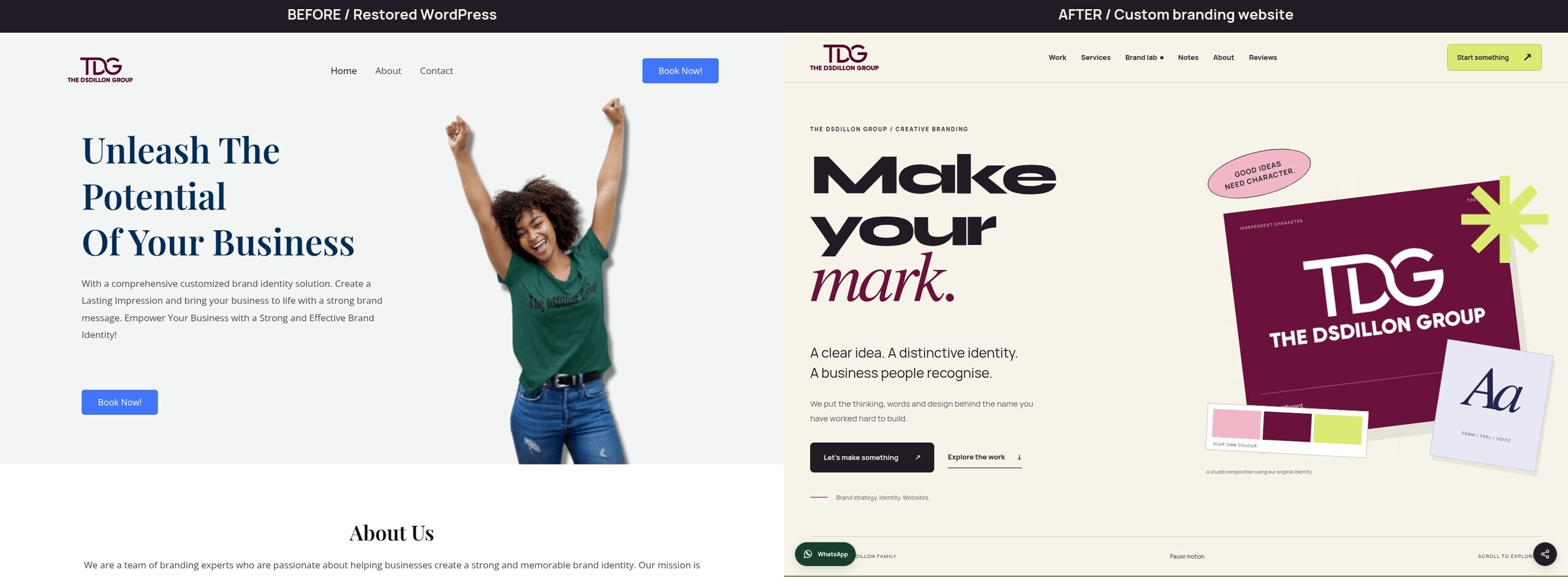
We restored that installation at thedsdillongroup.dsdillon.com and checked the Home, About, Contact and Portfolio pages, along with the sample page included in the backup. That brought the existing design and content back into view before any redesign decisions were made.
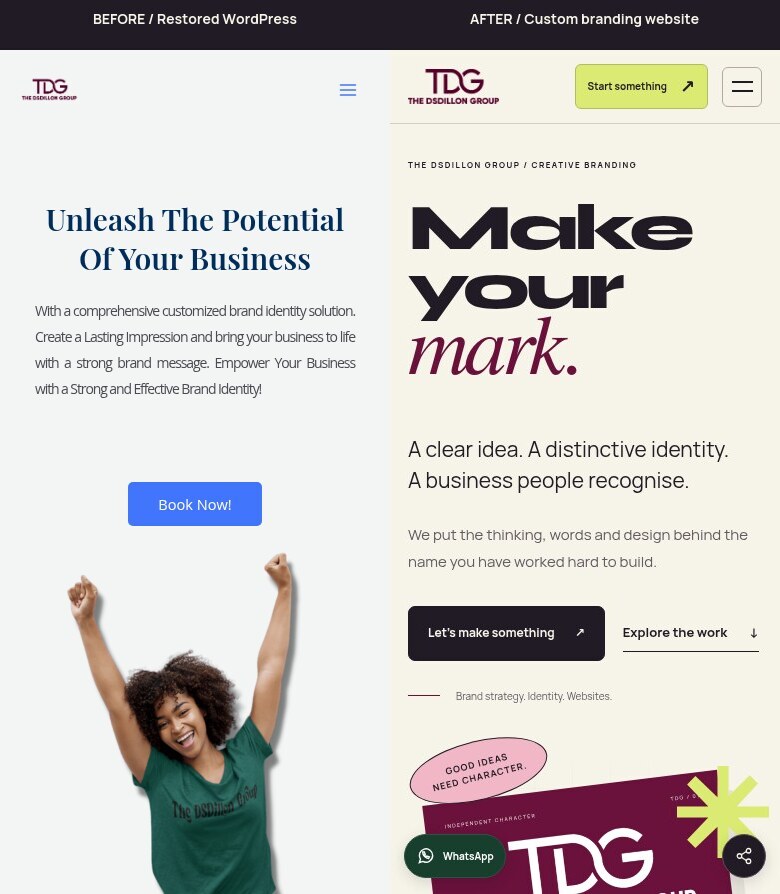
Desktop and mobile screenshots were taken from the restored site. The original archive, database and WordPress installation remain privately preserved. They provide the reference for the before images shown here.
Finding the questions behind a branding enquiry
The research looked at public search suggestions, relevant provider pages and primary documentation. Questions about branding costs, package contents, project timelines, logo files, rebranding and writing a brief shaped the page plan. They reflect the practical uncertainties a business owner brings to a first meeting.
The site now gives those subjects individual notes, linked to the relevant service. Someone considering a new identity can read what a package should contain, understand the files involved and prepare a useful brief before making contact.
Google, Adobe, W3C and USPTO references support the relevant technical and naming guidance. Search suggestions were treated as clues to useful questions. They were not recorded as measured monthly demand.
Related guidance: Adobe: vector artwork and file formats · USPTO: checking a proposed trademark
Keeping the TDG identity at the centre
The existing burgundy TDG logo became the starting point for the design. The homepage places it inside a layered studio composition with colour swatches, a type specimen and the headline Make your mark. Warm cream, burgundy, pale pink, lavender and a bright yellow-green accent give the pages a distinctive character.
Large display lettering sits alongside quieter body copy. Angled artwork, movement and changes of scale carry the creative theme through the website. The main navigation still gives visitors a straightforward route to Work, Services, the Brand Lab, Notes, About and Reviews.
A pause control and support for reduced-motion preferences are included. The original mark remains recognisable across the header, artwork and app icon.
Giving visitors a place to try ideas
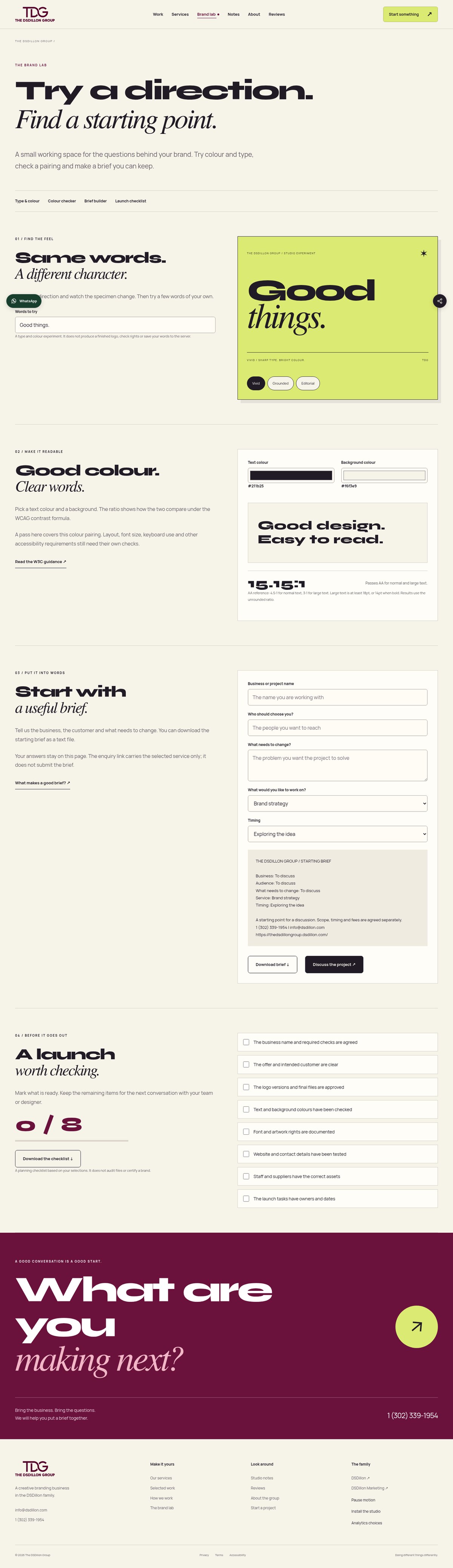
The Brand Lab gives visitors something practical to do with the ideas described on the service pages. They can enter a few words, switch between Vivid, Grounded and Editorial directions, and see how typography and colour change the character of the same message.
The colour checker accepts a text colour and a background, calculates their contrast ratio and explains the relevant text-size thresholds. It links to W3C guidance and makes clear that checking one colour pairing is only one part of an accessibility review.
The brief builder asks about the business, its intended customer, the change needed, the service and the timing. Visitors can download the brief as a text file. An eight-point launch checklist provides another useful takeaway. These tools run in the browser; their text inputs stay out of the analytics.
Related guidance: W3C: text contrast guidance
Building the pages and the route to contact
The published custom site contains 29 indexable pages. Six detailed service pages and nine branding notes sit alongside the Brand Lab, process information, selected work, reviews and contact pages. The public application uses generated HTML, custom CSS and JavaScript, with PHP handling enquiries and first-party measurement.
Important copy is present in the HTML delivered with each page. That gives people a readable explanation of the service and gives search crawlers the same information to work with. Shared navigation, page titles, canonical addresses and internal links are generated consistently.
Calls and WhatsApp use 1 (302) 339-1954. The enquiry address is info@dsdillon.com. The form carries the selected service into a three-step process, checks the required details and lets the visitor review the enquiry before sending it.
Keeping the work and the reviews in context
The work section includes Wage Master and DSDillon Marketing as DSDillon-family projects. It uses actual identities and website captures, with links to the wider project records. Visitors can inspect the finished websites and the work behind them.
The reviews page preserves 89 entries from the DSDillon family's November 2024 review archive: 64 Google reviews and 25 Facebook recommendations. Their original names, dates and comments remain intact, including entries that contain a rating without a written comment.
The collection is labelled as feedback across DSDillon businesses and services. It is a historical record. Compact previews, expansion controls and filtering make that record easier to browse on a phone.
Connecting measurement to the website
The Group has its own active first-party website reporting profile. The connection records permitted page visits, contact-button activity, sharing and selected interactions. Its search property is also registered, with the United States recorded as the target market and observation enabled.
Optional analytics begin after the visitor allows measurement. The integration uses site-specific cookies and respects Do Not Track and Global Privacy Control. Enquiry values and Brand Lab inputs are excluded, and cross-property identity matching is disabled.
Fresh tests checked page visits, telephone, email and WhatsApp clicks, share-link creation, copying and withdrawal of analytics permission. The verification traffic carries a test label so it can be recognised in reporting. A recorded click describes that action; a completed conversation or sale needs separate evidence.
Checking the public website
The launch record includes 68 desktop, tablet and mobile page checks with no reported failures. Those checks covered page responses, images, headings, horizontal overflow and browser errors. Navigation, visual-direction controls, sharing, back-to-top behaviour, the Brand Lab and review controls were also exercised.
The enquiry tests checked required fields, successful storage, the visitor's reference number, repeat-submission handling and rejection of an invalid form token. The mail log confirms that the controlled notification reached the existing mailbox behind info@dsdillon.com.
Older page addresses are handled through the migration rules, and the former WordPress administration paths are retired. The saved installation and backups remain available privately. The before-and-after images document the actual published versions at matching screen sizes.
The result at publication
The DSDillon Group now has a working custom branding website with its original identity, developed service information, practical tools, a tested enquiry route and separate first-party reporting. The design gives the business a clear creative presence and gives visitors several useful ways to prepare a project.
The search setup includes page metadata, structured information, internal links, a sitemap and crawl controls. The content follows Google Search guidance on accessible, useful pages.
This case study records the recovery, design and functionality delivered at launch. Ongoing measurement can track what visitors read, use and ask for, followed by the quality of the business conversations that result.
Related guidance: Google Search: AI features and your website
See the work in its current form
The screenshot records the public website at the time this case study was prepared. Because websites, products, programs and promotions can change, the live destination is the best place to review the current experience.
Need a website built around a commercial problem?
DSDillon designs websites around customer needs, business credibility, search visibility and measurable conversion paths.