
Logo design, website recovery and a custom-built payroll website for Wage Master.
DSDillon designed the Wage Master logo and later recovered the business's website after its original domain expired. The next stage preserved that brand identity and rebuilt the public experience as a custom-coded payroll and financial-administration website. The project brings together employer-focused research, 24 indexable pages, a guided enquiry form, practical planning tools and a documented before-and-after record.
Wage Master
Sector: Payroll outsourcing, financial administration and employee benefits administration
Market: Trinidad & Tobago
Primary search theme: payroll website design Trinidad
Live website: https://wagemasterz.dsdillon.com
The Wage Master identity.

DSDillon designed the original Wage Master logo. The recovered artwork is retained throughout the custom website, including the header, footer and social-sharing presentation.
DSDillon designed the original Wage Master logo
DSDillon's work for Wage Master includes the original logo design. That contribution is part of the project history and remains visible in the rebuilt website. The existing financial-chart symbol, green and blue artwork and Wage Master wordmark were retained as the business's recognisable identity.
The recovery process brought the original transparent logo asset back from the website files. For the custom build, the artwork was prepared as a browser-safe, 8-bit image and used consistently in the header, footer and social-sharing image. The favicon also comes from the existing brand files.
The new visual system uses dark green, pale neutral backgrounds and restrained green accents around that established logo. The case study shows the actual logo supplied by the recovered files. No alternative mark or invented logo-development history has been substituted for DSDillon's original work.
Recovering the website after the original domain expired
The original wagemasterz.com domain had expired. An inspection of the owner's hosting account located the original site directory and archived backups. The recovery used the 4 November 2023 archive, which contained the WordPress files, media, theme, plugins and a database export.
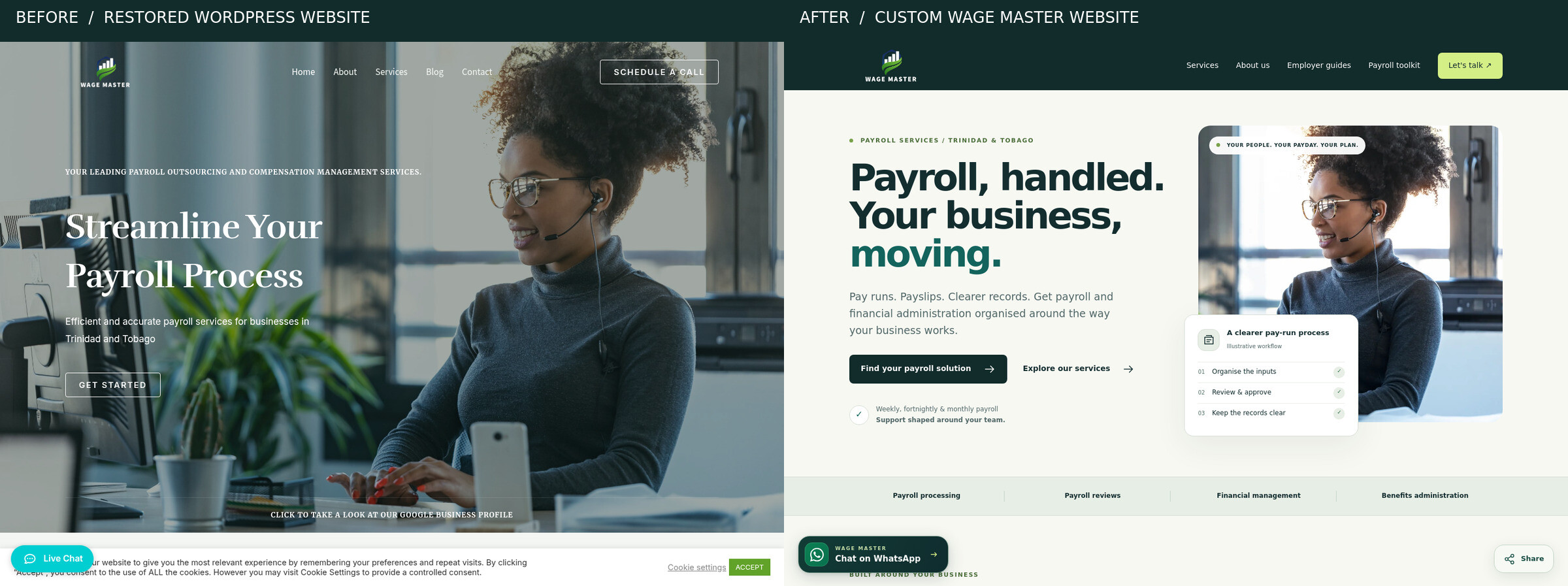
The website was first restored to wagemasterz.dsdillon.com so the original content and design could be inspected. That restored version supplied the starting point for the next phase and the genuine before screenshots. A copy of the recovered WordPress installation and the original archive were retained outside the new public website.
This sequence preserved the material needed to make an informed redesign: the existing service offer, original brand assets, established page addresses and an inspectable record of the earlier experience.
Researching employer questions and service-search intent
Research explored public search results around payroll outsourcing in Trinidad and Tobago, payroll pricing, PAYE and NIS administration, TD4 preparation, payroll reviews, bookkeeping and cash-flow planning. Local provider pages helped identify the language and service distinctions present in the market. IRD and NIBTT sources were used to check statutory references.
The resulting information architecture gives payroll outsourcing, payroll reviews, financial management and benefits administration their own service pages. An employer guide collection addresses the cost and scope of outsourcing, first-payroll preparation, year-end records, software selection and financial administration.
The research identifies relevant payroll questions from public search results and market pages, then maps those questions to service and guide content. Future Search Console and enquiry data can show which pages attract useful enquiries.
A custom-coded public website with 24 indexable pages
The replacement is built with pre-rendered HTML, custom CSS and JavaScript, with a small PHP layer for the enquiry form and first-party action counters. WordPress, Elementor and their plugin runtime are absent from the new public application.
The published architecture contains a homepage, service overview, four detailed service pages, an About page, an employer-guide index, eleven guides, a payroll toolkit, a Contact page and three policy pages. A separate error page returns the appropriate not-found response.
Important content is present in the initial HTML. Visitors and crawlers can read the service explanations and guides without relying on JavaScript to fetch the copy. Shared navigation, image sizing, metadata and responsive styles are generated consistently across the route set.
Interactive features tied to real visitor decisions
The homepage service finder lets a visitor identify the issue closest to their situation: setting up payroll, administration workload, records needing review or financial clarity. Its output links to the relevant service or guide.
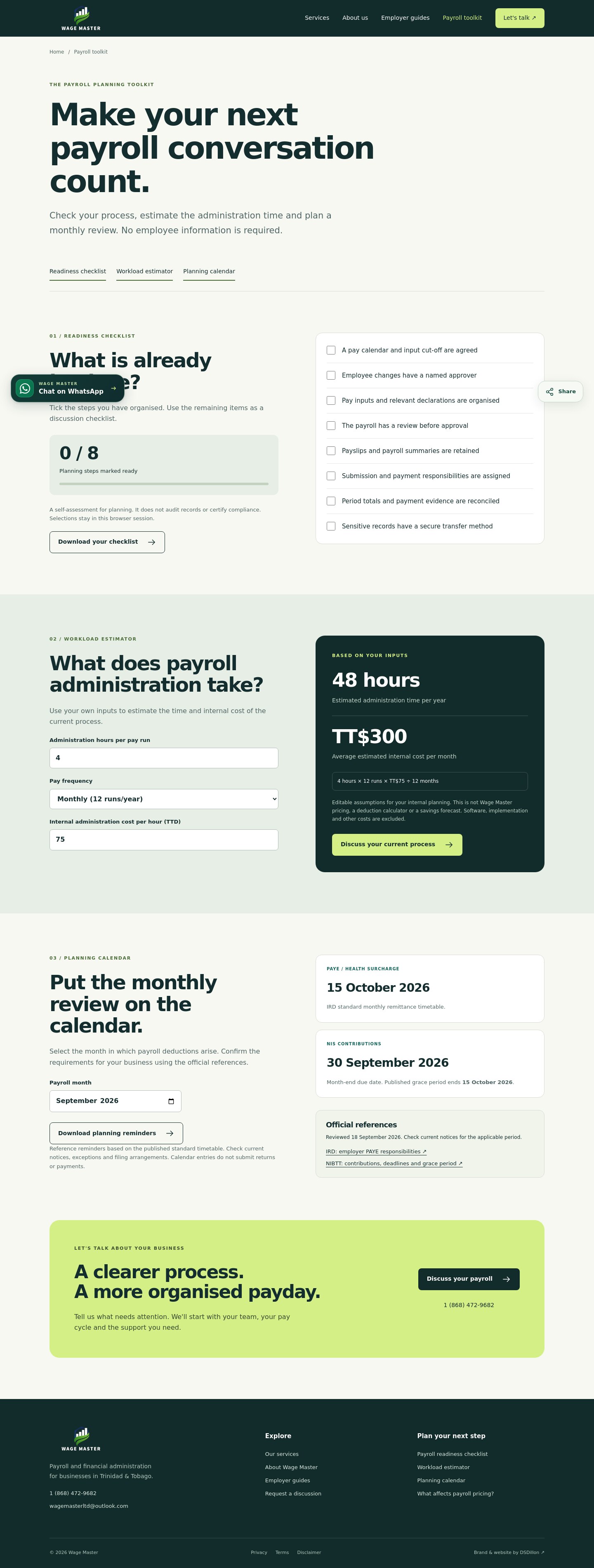
The toolkit includes an eight-item payroll-readiness checklist, a downloadable text checklist, an administration workload estimator and a downloadable calendar file. The estimator uses the visitor's own hours, pay frequency and hourly-cost assumptions. It is clearly labelled as an internal planning calculation; it does not quote Wage Master's fees or calculate employee take-home pay.
The employer guide library supports text search and topic filtering. Mobile navigation, native sharing or copy-link fallback, scroll-to-top controls and phone actions provide practical navigation support throughout the site.
A guided enquiry process and updated contact information
The new enquiry form collects the service requirement, employee-count range, pay cycle, priority and timeframe before asking for business contact details. A review step allows the visitor to inspect the information before submitting it.
The site uses the contact details supplied for this build: 1 (868) 472-9682 and wagemasterltd@outlook.com. Telephone and email links use those destinations. The form warns visitors to leave employee salary records, identification numbers, banking details and medical information out of the public enquiry.
The server validates submitted fields, checks the request origin and form-session token, applies a honeypot and rate limit, and stores accepted enquiries in a restricted directory outside the public website. Each accepted submission receives a reference. Email-notification status is recorded separately from the successful storage of the enquiry.
Search foundations built into the content
The technical implementation includes unique page titles and descriptions, canonical URLs, a crawlable sitemap, robots controls, descriptive image assets and internal links between services, guides and tools. Organization, website, service, article and breadcrumb structured data describe the information actually shown.
Employer guides link to the relevant official sources. For example, the TD4 guide points to IRD's annual-return instructions, and the monthly planner points to the published IRD and NIBTT timetables. The calendar includes a reminder to check current notices and applicable circumstances.
The implementation follows Google Search guidance on accessible content, clear internal linking and structured data that matches the page. A descriptive llms.txt directory is also published.
Documenting the migration and preserving the evidence
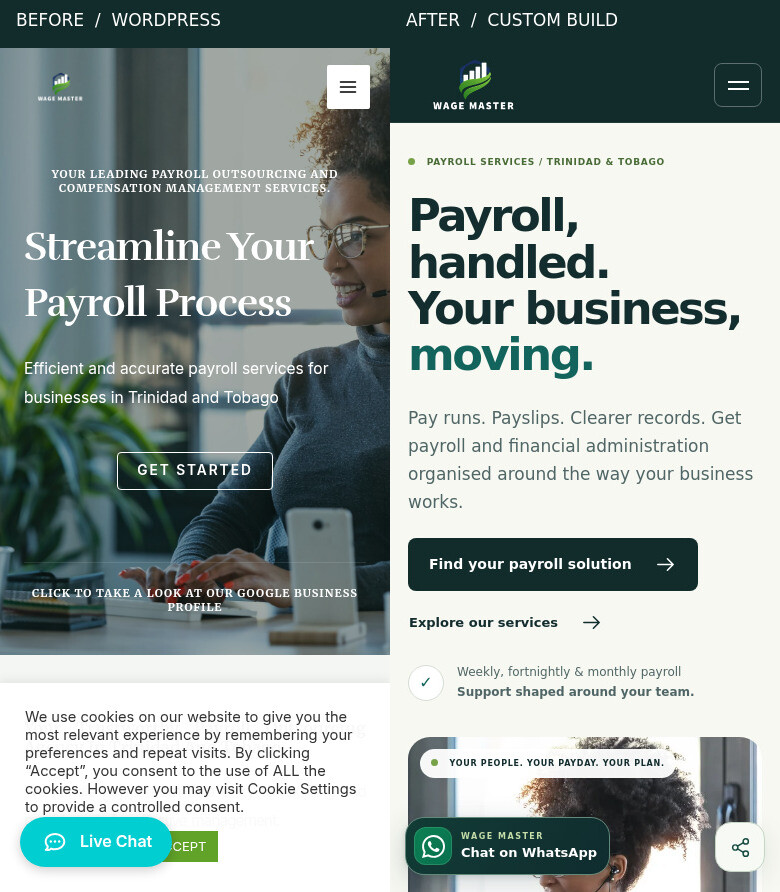
The before images were captured from the restored public WordPress website. The after images were captured from the custom website after publication. Desktop and mobile views use recorded viewport dimensions, allowing the visual changes to be inspected directly.
Existing service and article addresses were retained where appropriate. Redirects cover the old privacy-page spelling and shorter service addresses. HTTPS remains the canonical public destination, and the former WordPress administration endpoints are retired from the new application.
The original archive, recovered WordPress copy, custom source, screenshots and verification records are retained on the owner's server. The public case study contains no employee records, private visitor information, server credentials or enquiry contents.
What was delivered
The verification process checks route responses, unique metadata, structured data, image loading, horizontal overflow, mobile navigation and the interactive tools. A controlled form test checks validation and server-side storage with test email notifications suppressed.
The website records limited first-party page and action counts without copying form contents into analytics. Those records provide an initial basis for reviewing use of the enquiry pathway and tools. They are implementation measurements, not a claim of improved sales or organic rankings.
This case study documents the logo design, recovery, custom development and tested functionality. Any claim about traffic growth, search position, enquiry quality or revenue will require a subsequent measurement period and supporting evidence.
Research references
IRD employer PAYE guidance · IRD annual return and TD4 guidance · NIBTT contribution schedules · Google Search guidance on AI features
See the work in its current form
The screenshot records the public website at the time this case study was prepared. Because websites, products, programs and promotions can change, the live destination is the best place to review the current experience.
Need a website built around a commercial problem?
DSDillon designs websites around customer needs, business credibility, search visibility and measurable conversion paths.