
WASA Clearance Certificate: How to Apply in Trinidad and Tobago
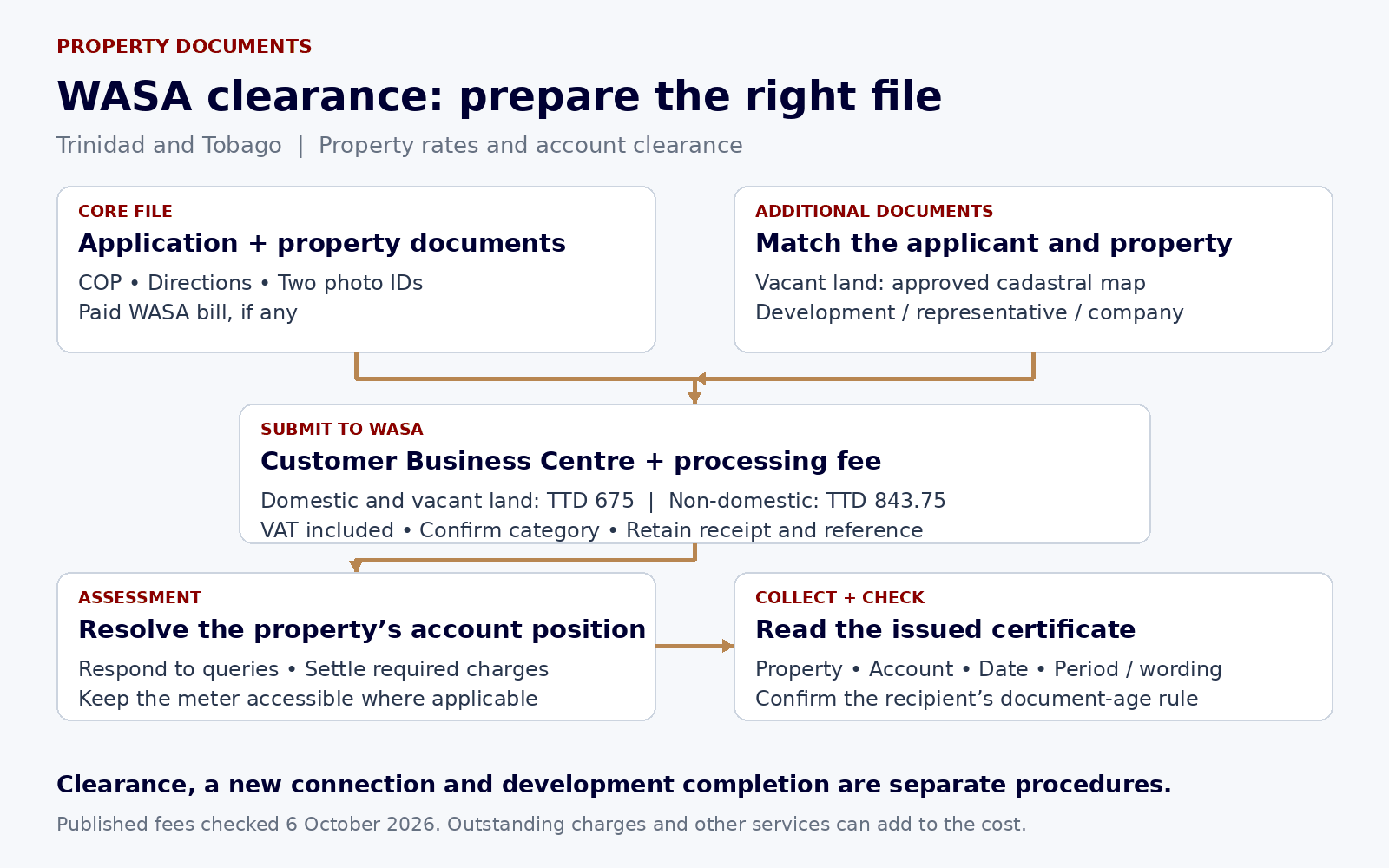
To obtain a WASA Clearance Certificate, complete WASA’s clearance application, assemble the property and identity documents, submit them to a Customer Business Centre and pay the applicable processing fee. WASA must establish the property’s account and rates position before issuing the relevant clearance. The current form lists TTD 675 for domestic property and vacant land, and TTD 843.75 for non-domestic property, including VAT.
What is a WASA Clearance Certificate used for?
A WASA Clearance Certificate is used in property transactions to establish the property’s WASA rates and charges position. Lenders may require it as part of their mortgage documents. First Citizens lists the certificate at its post-approval stage, while RBC’s residential home purchase checklist asks for a certificate issued within the preceding three months.
Paying a WASA bill produces payment evidence. Obtaining the clearance certificate is a separate application, with its own documents and fee. Submit the certificate requested by your lender or attorney rather than assuming that a receipt is sufficient.
A clearance certificate does not grant residential planning permission, transfer land ownership or approve a new water connection. WASA also deals with technical development and completion approvals. Those documents serve different purposes and can be required alongside clearance.
Step 1: Check the property, account and transaction deadline
Ask the owner for the WASA account ID, available bills and receipts, and any earlier clearance or development completion documents. Compare the property address and owner details with the title and survey file. Tell WASA if the parcel is vacant, has never received a bill, is part of a private development or has changed ownership.
If you cannot find an account, explain that to WASA and provide the property identification documents. Do not borrow a neighbouring account number or assume that having no pipe connection proves that there is no WASA record or liability. WASA publishes a separate procedure for owners or occupiers who have never received a bill.
Ask your attorney or lender when the certificate is needed and how recent it must be at that stage. This helps you plan the application without treating a particular bank’s document-age rule as a universal WASA expiry rule.
Step 2: Download the current form and gather the documents
Use the Clearance Certificate form linked from WASA’s current Application Forms page. Read both pages: the first contains the application and declarations; the second contains the documents, fee and Customer Business Centre list. Older forms remain searchable online.
WASA requires a Certificate of Payment, commonly called a COP, from the District Revenue Office, City Hall or Borough Corporation. Contact the office responsible for the property and ask how to obtain the COP for a WASA clearance application. A WASA payment receipt is a different document. Do not assume that an income-tax clearance certificate will substitute for it.
Prepare a location sketch with clear directions, landmarks and the structures on the site. This helps WASA identify the actual premises. For vacant land, its current checklist requires a cadastral map approved and stamped by Lands and Surveys. An estate agent’s layout or online map screenshot is not that document.
- Completed clearance application form.
- Certificate of Payment from the relevant revenue office, City Hall or Borough Corporation.
- Location sketch, directions, landmarks and description of structures.
- Approved and stamped cadastral map for vacant land.
- Paid WASA bill for the property, if any.
- Two valid photo IDs: the listed types are National ID card, driver’s permit and passport.
- Original Completion Certificate where the private-development requirement applies.
- Authorization, company records or new-owner / tenant documents where applicable.
Step 3: Complete the applicant and property details
Complete the form in block letters. Enter the account ID where one exists. Complete the applicant, previous owner, property owner and company fields as applicable. Use the correct legal names and provide working telephone and email contacts. Check the e-billing choice and contact permissions before signing.
Record the property’s location using the building or apartment number, lot, light pole or mile marker, street, town and postcode fields that apply. Add a separate mailing address if correspondence should go elsewhere.
State whether the site is vacant, completed or under construction. For construction, the form asks about percentage completion and the expected completion date. Identify the structure type and actual activity, including domestic, commercial, industrial, agricultural or mixed use where applicable. Answer the VAT-registration fields accurately if relevant.
Complete the development and approval questions. The form asks whether the property is within a development, its name, whether TCPD approval exists and whether a WASA Completion Certificate exists. Attach the TCPD approval copy if you indicate that approval is available. Do not describe a Status of Land letter as an approval for works.
Step 4: Describe the water and sewerage arrangements accurately
The form asks whether water service is metered or unmetered; whether the premises are within 45 metres, or 150 feet, of a sewer main; and, for vacant land, whether a standpipe is within a quarter mile. It also asks about sources such as an internal supply, yard tap, standpipe, communal tank, spring or well.
Answer the disconnection and swimming-pool questions and provide the details requested. These questions help WASA assess the actual circumstances. They are not instructions to classify every unconnected parcel as exempt from charges.
If you do not know a service detail, ask WASA to clarify how it should be recorded. Read the declaration carefully and sign in your actual capacity, such as owner, tenant or agent. Leave the fields marked for official use to WASA.
Step 5: Add the documents for your applicant category
A person applying for the owner needs written authorization and identification. WASA’s authorization template allows the owner or other authorizing person to specify both applying for and collecting the clearance certificate. The template asks for photocopies of two forms of identification for the authorizing person and the representative.
Where the owner lives abroad, WASA’s billing instructions require notarized owner documents and refer to a Notary Public or Notification Certificate. Confirm the exact document and certification acceptable for the owner’s country before arranging overseas execution or courier delivery.
Company applicants must provide incorporation records identifying directors and any relevant certificate and articles of amendment. The checklist asks for two photo IDs for each of a director and corporate officer, and permits those officers to appoint a representative who also provides two photo IDs. WASA’s billing page additionally calls for a stamped company-letterhead authorization signed by at least two directors. Confirm the required signatories for the company’s circumstances before attendance.
| Applicant circumstance | Additional preparation |
|---|---|
| New owner | Original registered deed with a copy, a statutory declaration prepared by a Commissioner of Affidavits, and the published TTD 95 name-change fee. |
| Registered tenant | Statutory declaration prepared by a Commissioner of Affidavits. |
| Unregistered tenant | Statutory declaration and the property owner’s authorization. |
| Representative | Authorization covering the task, with the identification required for the authorizer and representative. |
| Owner abroad | Confirm the required notarial certification and submit the notarized owner documents. |
| Company | Incorporation and amendment records where relevant, officer identification and company authorization; confirm required signatories. |
Step 6: Submit the application and pay the correct fee
Submit the completed file through a WASA Customer Business Centre. The current form lists cash, certified cheque, credit card and debit card as payment methods. Check the chosen centre’s service arrangements before visiting, especially where another person is attending for you.
The processing fee is non-refundable. Keep the receipt and any application or case reference. The certificate fee is separate from outstanding WASA charges, a name change, professional fees and the cost of obtaining supporting documents.
An older clearance form still available online shows TTD 450. The current form linked from WASA’s forms page and its customer account services page show the amounts below, checked on 6 October 2026. Confirm the applicable category with WASA if the property has mixed or uncertain use.
| Service / category | Published charge | Important detail |
|---|---|---|
| Domestic property and vacant land | TTD 675 | VAT included; current application form. |
| Non-domestic property | TTD 843.75 | VAT included. |
| Certified copy of a clearance certificate | TTD 15 | VAT excluded in WASA’s billing-services listing. |
| Name change for a new owner | TTD 95 | Additional service, where required. |
Step 7: Resolve account queries and keep the meter accessible
WASA may need to resolve the property identity, ownership record, use or account details before issuing clearance. Keep copies of what you supplied and respond to specific requests. If the account has outstanding charges, ask WASA for the amount and period that must be settled and retain the receipts.
If you dispute an amount, raise the billing query with WASA and keep its reference. Do not assume that making a part payment, signing a payment arrangement or paying only the application fee produces a clearance certificate.
For metered premises, the application checklist requires the meter to be accessible. Arrange access where a locked gate or other obstruction prevents it. Tell WASA who can provide access and keep that contact available.
WASA’s current clearance form and billing instructions do not give a single processing deadline for every application. Ask the receiving centre for the expected next step and collection arrangements for your file. Do not rely on an unverified promise of seven days or same-day issue when setting a sale-completion date.
Step 8: Collect the certificate and check what it says
Follow the collection instructions given by WASA. If a representative will collect it, make sure the authorization covers collection as well as applying, and that the representative has the required identification.
Check the owner or customer name, property description, account reference where applicable, issue date, period addressed and the precise statement WASA makes. Ask WASA to correct any mismatch with the intended property before giving the document to the lender or attorney.
Keep a copy with the application and payment receipts. If a recipient requires an original or certified copy, ask that recipient which is acceptable. A certificate addressing an account position should not be read as a guarantee of future supply, clear legal title or compliance with all construction approvals.
Step 9: Confirm the lender’s date requirement before completion
There is no universal certificate-age rule stated in the current WASA application form or clearance instructions. Read the issued certificate and ask the receiving lender or attorney whether it meets their requirements at the date they intend to use it.
RBC’s published residential mortgage checklist specifically asks for a WASA Clearance Certificate issued within the last three months for a residential home purchase. That is a lender’s checklist requirement. It does not establish that every WASA certificate expires after three months for every purpose.
If the transaction is delayed, check whether an updated certificate is needed. Do not alter the date or wording of an existing certificate. Ask WASA about the appropriate application and the recipient about the document it will accept.
Vacant land, online applications and completion certificates
Do I need clearance for vacant land? A lender or attorney can require it for a land transaction. WASA’s current form explicitly includes vacant land in the TTD 675 category and requires the approved cadastral map. Tell WASA if no bill or account can be found so it can establish the position of the identified parcel.
Can I apply entirely online? WASA publishes the form for download and directs customers to its Customer Business Centres. Those instructions do not establish a complete online clearance submission and issue process. Confirm any additional channel directly with WASA before sending personal documents or payment.
Can I use DevelopTT? DevelopTT handles development-related water and sewerage approvals. Do not select a construction service expecting it to produce clearance of the property’s rates. Use WASA’s clearance procedure for that document.
Is a Completion Certificate the same thing? No. WASA’s clearance checklist itself asks for a Completion Certificate for the relevant private-development situation. Its billing page describes properties in developments with approved water reticulation systems. Ask the developer and WASA for the applicable completion document; a clearance receipt does not replace it.
WASA offices, forms and professional assistance
WASA’s main telephone number is 868-662-2302. The customer contact centre numbers include 800-4420 and 800-4426. Use the official contact page for current extensions and confirm counter hours and clearance-service arrangements before travelling.
The Customer Business Centres below are listed by WASA. An attorney can assist with a conveyance, estate or ownership issue; a Commissioner of Affidavits prepares the required statutory declaration; a licensed land surveyor can help identify or obtain the appropriate survey information. Use the linked professional directory and agree the scope of paid assistance directly.
| Centre | Location |
|---|---|
| St Joseph | Farm Road |
| Port of Spain | Kew Place, Phillip Street |
| San Fernando | Mon Chagrin Street |
| Chaguanas | Corner of Manic Street and Market Street |
| Arima | O’Meara Plaza, O’Meara Road |
| Trincity / Arouca | Golden Grove Road |
| Point Fortin | Guapo Main Road |
| Princes Town | King Street |
| Tobago | Crooks River, Scarborough; 868-639-5152 / 639-5056 |
- WASA Customer Business Centres and contact numbers
- WASA application forms: current downloads
- WASA Clearance Certificate application form and checklist
- WASA authorization letter: apply for and collect a certificate
- WASA statutory declaration specimen
- WASA clearance fees and additional applicant requirements
- Surveyors, attorneys, authorities and application forms
Discuss your land project
Tell us the location, the documents you hold and the development you have in mind.
Contact DSDillonThis guide provides general information. Obtain advice on the title, lease, site and approvals for your particular proposal.