
Deeds in Trinidad and Tobago: Types and Buyer Checks
A deed is a formal legal instrument. Depending on its purpose, it can transfer an interest in land, grant a lease, secure a mortgage or record another legal transaction. Reading the title on the document is only the beginning. A buyer needs to establish which land it affects, what interest it deals with, who had authority to sign, and how it fits into the property’s ownership history.
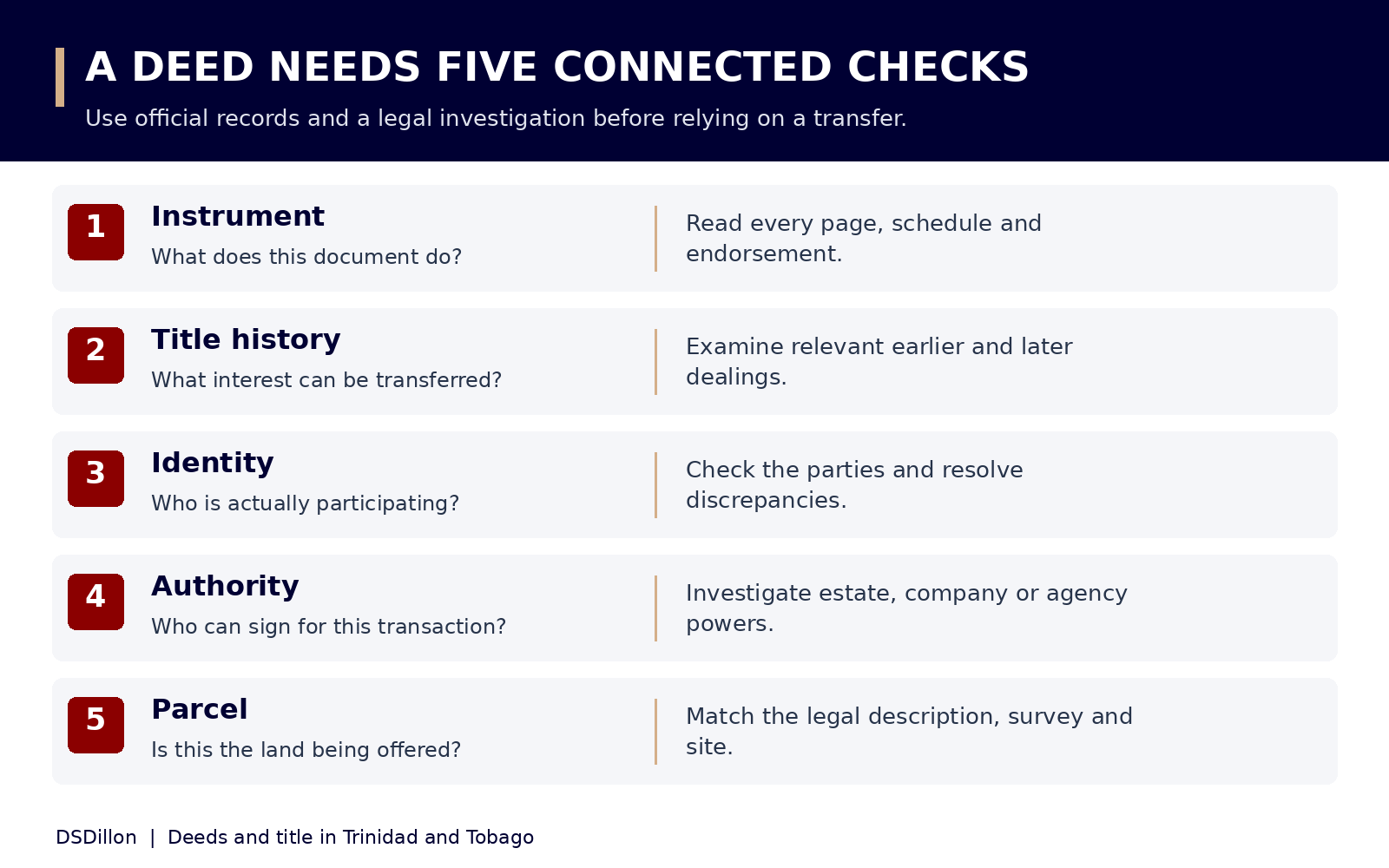
What is the difference between a deed and title?
A deed records a legal transaction. Title is the legal basis of a person’s ownership or other interest in the property. A conveyance in someone’s name is part of the evidence an attorney investigates when reporting on title. An older deed can remain a genuine historical record after that person has sold the land.
Ask two questions: “What does this document do?” and “What rights does the proposed seller have now?” A deed of mortgage, a power of attorney and a deed of conveyance perform different functions, although each may appear in a property file.
Common Law deeds and Real Property Act titles
Trinidad and Tobago uses a Common Law conveyancing system and a registered system under the Real Property Act, often called the RPA or RPO system. Establish the system before ordering searches or preparing transfer documents.
| System | Main records | What to ask your attorney |
|---|---|---|
| Common Law | Deeds and the chain of transactions affecting the land. | Investigate the chain of title, relevant registrations and the seller’s interest. |
| Real Property Act | Certificate of Title and registered instruments, including transfers and mortgages. | Check the current title record, endorsements and relevant dealings under the Act. |
What are the different types of deeds?
The document’s operative wording determines what it does. The following names describe common transactions; they do not establish that a particular document was properly executed or that its maker had the rights being dealt with.
| Document | Usual purpose | Check before relying on it |
|---|---|---|
| Deed of conveyance | Transfers an interest in Common Law land, commonly on a sale. | The seller, interest conveyed, property schedule, price and earlier title. |
| Deed of gift | Transfers property without consideration. | The donor’s ownership, voluntary decision, any reserved interest and registration requirements. |
| Deed of assent | Transfers a deceased owner’s Common Law interest from the legal personal representative to an entitled beneficiary. | The estate, grant, representative’s authority and beneficiary’s entitlement. |
| Deed of lease | Grants a lease on stated terms. | The term, rent, permitted use, covenants, renewal provisions and consent requirements. |
| Deed of assignment | Transfers an existing interest, often a leasehold interest. | What is assigned, remaining lease term and required landlord’s consent. |
| Deed of mortgage | Provides security over an interest in property. | The borrower, lender, land, secured obligations and earlier charges. |
| Deed of release or partial release | Releases the interest or security identified in the document, wholly or in part. | Which mortgage, obligations and parcels are actually released. |
| Deed of partition | Divides jointly held property interests between co-owners. | The interests allocated, plans and any separate subdivision approvals needed. |
| Deed of rectification | Corrects an identified error in an earlier instrument. | The error, affected parties and legal basis for correction. |
| Power of attorney | Authorises another person to act within specified powers. | Whether it genuinely grants the power needed and remains effective. |
Is a deed poll proof that someone owns land?
No. A deed poll used for a change of name does not establish ownership of a property held by someone with that name. The Law Association has warned that impersonators can use a name change to present themselves as the true owner. Where names have changed, ask the attorney to investigate the identity history as well as the title.
Giving land to a child or relative: deeds of gift
A gift transfers property during the donor’s lifetime. It should be made voluntarily by a donor who understands the transaction. Independent advice is especially important where a donor wants to continue living in the property: a retained life interest must be addressed in the legal documents.
Legal Aid’s guidance explains that gifts require title checks, preparation, proper execution, stamping and registration. Section 18 of the Registration of Deeds Act imposes a twelve-month registration requirement for deeds of gift or settlement; these instruments take effect only on registration. Obtain advice promptly if that period has passed. Do not treat twelve months as a general deadline for every kind of conveyance.
Inherited land: wills, grants and deeds of assent
A will, a grant of probate and a deed of assent have different roles. A will records testamentary wishes. Probate concerns the will and the executor’s authority; letters of administration concern an administrator’s authority. An assent deals with vesting the deceased’s interest in an entitled beneficiary.
For an estate transaction, ask the attorney to check the deceased’s title, the grant and any relevant will, the identity and authority of the personal representative, and the proposed transfer. The Judiciary offers probate searches and office-copy requests. Its e-services page also links to verification of grants of probate and letters of administration.
Where several relatives claim the same property, do not assume a family member can sell the entire parcel because they occupy it or hold the papers. Establish the relevant estate and ownership interests first.
How to read a deed before your legal appointment
Make a complete, legible copy, including schedules, plans, endorsements and signature pages. Use this checklist to prepare questions for the attorney. Leave any corrections to the appropriate legal process.
| Part of the document | What to record |
|---|---|
| Parties and capacities | Names and whether they act personally, for a company, as an estate representative or under a power of attorney. |
| Dates | Date of the deed, execution information, stamping information and registration endorsement. Record these separately. |
| Recitals | The earlier transactions or circumstances the deed describes. Obtain referenced documents where required for the title investigation. |
| Operative clauses | The interest transferred or created, the recipient and any reserved rights. |
| Consideration | The stated price or other basis of the transaction. A gift may have no consideration. |
| Property schedule and plan | Location, area, boundaries, lot and plan references. Compare these with the land offered. |
| Covenants and reservations | Rights of way, restrictions, lease terms and other obligations or retained rights. |
| Execution and registration | Signatures, attestation and proof of execution, attorney preparation information and the registry reference. |
Why registration and registration dates matter
In Grant v Jackman, [2026] UKPC 13, the Privy Council explained section 16 of the Registration of Deeds Act. Registration timing can determine priority between competing deeds. The priority rule in subsection (1) can apply to a voluntary disposition such as an assent, subject to the fraud exception. Subsection (2) provides separate protection for certain subsequent purchasers for value and mortgagees without notice.
The case also distinguishes execution from registration. A deed can have legal effect before registration, subject to rules that specifically depend on registration and the consequences of non-registration. Therefore neither “the oldest deed always wins” nor “every unregistered deed is a forgery” is a safe rule. An attorney must apply the law to the competing instruments and facts.
What happens when a property deed is prepared and registered?
The document and registration route depend on the transaction and title system. Use the following stages to discuss the work and expected deliverables with the conveyancing attorney.
- 1. Identify the transaction and parties. Provide identification, title papers, plans and documents establishing any estate, company or agency authority.
- 2. Investigate title. The attorney arranges appropriate searches, examines the documents and raises questions about ownership, encumbrances, missing records and authority.
- 3. Settle the terms and draft. Confirm the correct parcel, interest, names, consideration, restrictions and necessary consents before signing.
- 4. Execute correctly. Follow the requirements for signatures, witnesses and proof of execution. Signing abroad can require a different procedure; arrange it with the attorney before signing.
- 5. Deal with stamp duty and applicable charges. The Land Registry identifies Inland Revenue stamping and, where relevant, land assurance requirements. Obtain the assessment and payment or exemption records applicable to the transaction.
- 6. Lodge through the appropriate registry process. Electronic submission of particulars, delivery of documents and completion of registration are separate stages. Retain lodgement receipts and resolve registry queries.
- 7. Confirm completion. Obtain the registered document or relevant registered-title evidence, the full reference and a written explanation of any outstanding matters. Keep copies with your property records.
What should a buyer check before paying a deposit?
Ask your own attorney to investigate the seller’s title and authority and to advise on the agreement before you sign or release funds. Obtain a written scope of work and fee quotation. Agree how searches will be brought up to date before completion, and how any mortgage discharge or required consent will be dealt with.
Keep the title investigation connected to the parcel itself. A licensed land surveyor can investigate a boundary or plan discrepancy. Planning approval, permitted use, legal access and utility requirements also need attention: the ownership instrument does not answer every development question.
- Who owns the interest being offered, and is the person signing authorised to transfer it?
- Do the schedule, survey and physical parcel match?
- What mortgages, restrictions, competing claims or missing documents remain unresolved?
- If the property is leasehold, what term remains and what consents are needed?
- What written conditions protect the buyer if title or required approvals are unsatisfactory?
Can a registered deed be fraudulent?
Yes. Registration is not a substitute for investigating authenticity and authority. In Peltier v Scott and others, the High Court found that the owner had not signed the disputed conveyance or sold the property, and ordered cancellation of that deed and subsequent conveyances.
What do searches, copies and deed preparation cost?
Request an itemised quotation separating professional fees, searches, certified copies, stamp duty, registration charges and any survey work. Costs depend on the transaction and the applicable charges. The amount paid for a certified copy is not the price of a legal title investigation.
Before paying for an online service, establish whether you are ordering a document image, a certified copy, a registry search or an attorney’s report on title. Ask what records and date range the work covers and what further checks remain.
Official records, forms and professional help
Use the Registrar General for land records and registration enquiries, the Judiciary for probate records, and an attorney for advice on title and transaction documents. Take a survey discrepancy to a licensed land surveyor. Our land forms and professionals directory brings the related services together.
Discuss your land project
Tell us the location, the documents you hold and the development you have in mind.
Contact DSDillonThis guide provides general information. Obtain advice on the title, lease, site and approvals for your particular proposal.