
Fraudulent Deeds in Trinidad and Tobago: What to Check
You cannot reliably identify a fraudulent deed from its paper, layout or registration number alone. The useful checks concern the official record, the people involved, their authority, the property and the history of the transaction. Treat a discrepancy as a reason to investigate before paying or signing.
Read the complete deeds guideCan a forged deed appear in the Land Registry?
Yes. The Financial Intelligence Unit’s May 2021 advisory describes fraudulent property transactions involving registered deeds and forged signatures. Stamping and registration therefore do not replace identity and authority checks.
Warning signs that need an explanation
A warning sign calls for further investigation. It does not establish guilt or prove that a document is forged. Ask for a documented explanation and let the attorney assess it with the complete records.
| Warning sign | Question to resolve |
|---|---|
| Names or signatures do not match | Which identity and execution records support the transaction? |
| Unexplained date gaps | What accounts for the sequence of events? |
| Conflicting property descriptions | Do all documents concern the same parcel and interest? |
| Competing conveyances | How do the transactions relate and what is their legal effect? |
| Pressure to pay before checks | Will the seller allow the agreed verification to be completed? |
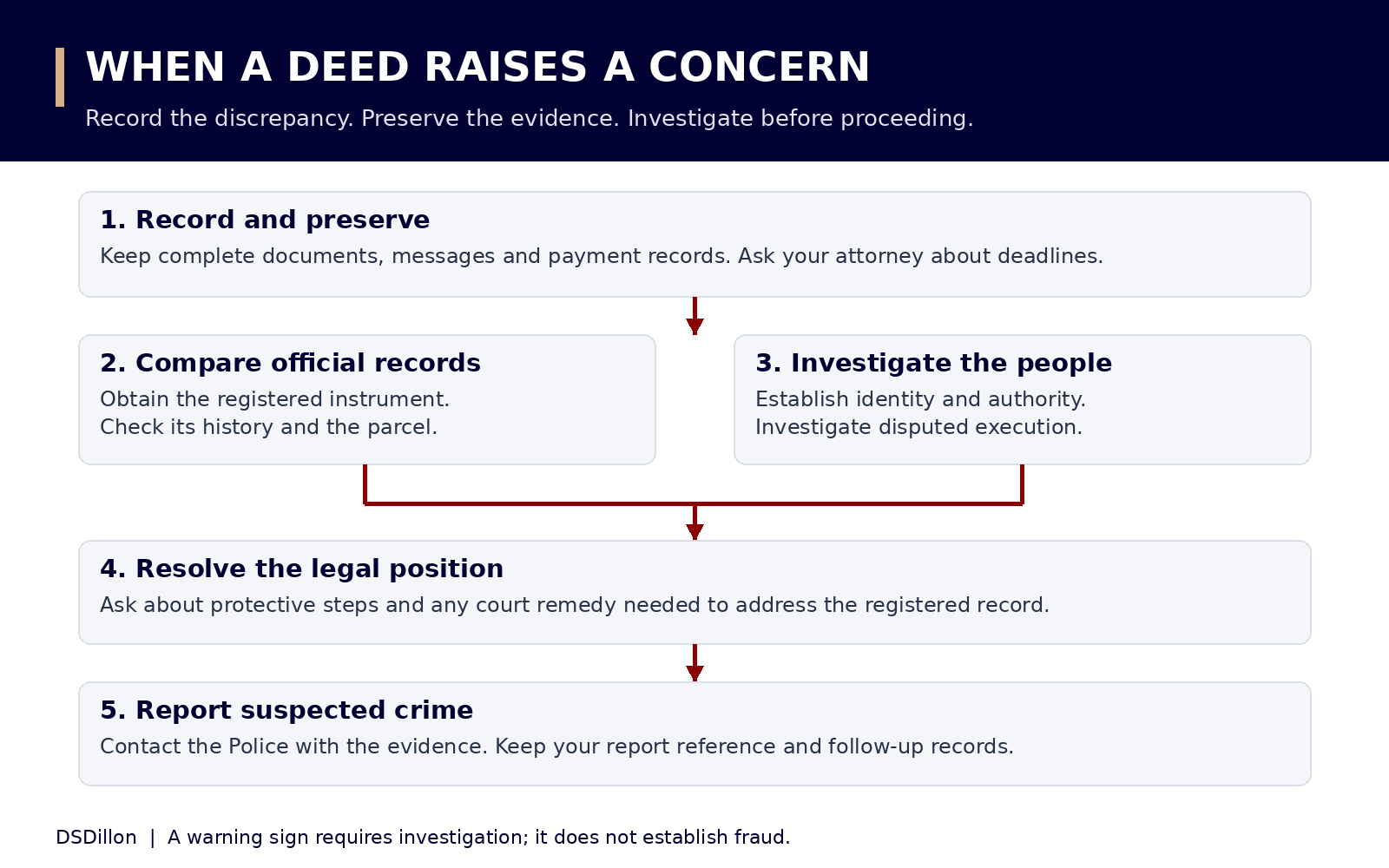
Step 1: pause the transaction and record the concern
If a material inconsistency appears, ask your attorney to address it before you release further money or sign additional documents. If a contract is already in place, obtain advice on your obligations, deadlines and available protective steps.
Write down the specific discrepancy: for example, the seller’s name differs from the registry copy, the schedule describes another lot, or a representative cannot supply the authority relied on. Keep the documents in their original condition.
Step 2: obtain and compare the official records
Obtain the relevant registered instrument or title record through the Registrar General’s services. Compare the complete document with the seller’s version, including its schedule, plan, execution pages and endorsements. A cover page or cropped photograph cannot support that comparison.
Have the attorney investigate earlier and later dealings and identify any mortgage, release, assignment, assent or other document relevant to the proposed transaction. Where records disagree, identify the precise document and passage requiring explanation.
Step 3: establish identity and authority to sign
Separate ownership from authority to act. A person may be an agent, attorney under a power of attorney, company officer or estate representative. The documents needed depend on the capacity in which they propose to sign.
| Who is offering the property? | What the attorney should investigate |
|---|---|
| Individual owner | Identity, ownership interest and whether the person is genuinely participating in the transaction. |
| Person acting under a power of attorney | The instrument, its authenticity, scope and continuing effectiveness for the proposed transaction. |
| Company representative | The company record and authority for this person and this transaction. |
| Executor or administrator | The estate records, grant and representative’s powers concerning the land. |
| One of several owners | The ownership interests and whose participation is needed to transfer the interest being offered. |
Step 4: check that the documents describe the land offered
Match the schedule and plan against the parcel being shown. Ask a licensed land surveyor to investigate uncertainty over boundaries, area or parcel identity. Record any unexplained difference between the advertisement, site and legal description.
Visit the property where access is lawful and arrange relevant enquiries about occupation. A site visit can reveal issues requiring investigation; occupation, a fence or a familiar neighbour’s account cannot settle legal ownership.
Step 5: investigate suspicious execution or signatures
Where execution is disputed, the attorney may need information from the persons said to have prepared or witnessed the document, reliable comparison material and a forensic document examiner. Preserve the best available originals and explain the origin of each copy.
In the Peltier case, expert evidence recognised that handwriting can vary naturally with age, health and stress. A lay comparison of two signatures is therefore insufficient to declare forgery. Equally, a visually convincing signature does not establish consent.
What the Peltier judgment teaches buyers
In Peltier v Scott and others, decided on 30 November 2021, the High Court examined a purported conveyance and subsequent sales. The evidence included the ownership history, the deceased owner’s circumstances and expert signature analysis. The court found that the owner had not executed the disputed conveyance or sold the property. It ordered that the disputed deed and later conveyances be cancelled and expunged.
The practical lesson is to investigate the underlying transaction and unresolved inconsistencies, even where instruments have been registered. The judgment concerns its particular facts; it is not a finding that every delayed registration is fraudulent.
Step 6: report suspected fraud and obtain advice on protecting the property
The Central Bank lists the TTPS Fraud Squad at (868) 625-2310 and (868) 623-2644, and fraud@ttps.gov.tt. Use the TTPS reporting service or contact the Police for guidance on submitting the evidence. Keep the report reference and the investigating officer’s contact details.
Ask the attorney promptly about protective proceedings if a sale, mortgage, eviction or construction threatens the property. The appropriate step depends on the title system and facts. A police report does not itself cancel a registered instrument or resolve ownership; court relief may be needed.
Prepare a chronological evidence file: the documents received, official copies obtained, relevant correspondence, payment records and the reasons for your concern. Preserve messages and receipts in their original form. Give copies to the appropriate professional or investigator and retain your own file.
How can owners reduce exposure to property fraud?
Keep title papers secure and maintain an organised record of transactions and official references. Arrange periodic checks on property you do not occupy. Keep estate administration and changes in representation under active review with the responsible attorney.
If you learn of an unfamiliar registered transaction, obtain its official record and seek legal advice promptly. Avoid public accusations while the facts are being investigated.
What does not prove fraud by itself?
A legitimate transaction may involve a tax exemption, differing execution and registration dates, an older reference format or natural variations in a signature. Investigate the explanation in context. Conversely, a professional appearance, paid stamp duty, an attorney’s printed name or a registry reference cannot independently establish authenticity.
A suspected forged deed, a genuine deed signed without the necessary authority and a genuine deed affected by a title defect raise different legal issues. Identify the issue accurately so the investigation and remedy address the actual problem.
Who can help with a suspicious property document?
An independent conveyancing attorney can investigate title and authority. A licensed land surveyor can investigate the parcel and boundary evidence. A forensic document examiner may be needed for disputed execution. The Registrar General supplies registry records; the Police investigate suspected criminal conduct.
Ask the professional to explain the scope, evidence required, likely next steps and charges. Legal Aid can explain its available advice services and eligibility. Do not assume that every service includes representation in a property dispute.
Discuss your land project
Tell us the location, the documents you hold and the development you have in mind.
Contact DSDillonThis guide provides general information. Obtain advice on the title, lease, site and approvals for your particular proposal.