
House, Townhouse, Condo or Apartment? Trinidad and Tobago
A house, townhouse, condo and apartment can offer different layouts and responsibilities. The building’s appearance does not tell you the complete ownership position. Compare the title or lease, the unit boundaries, rights over shared areas, management obligations and approved use before deciding which property meets your needs.
Read the complete property types guideHow do the main residential types compare?
Use this table to organise enquiries. Responsibilities and rights must be confirmed in the documents for the property.
| Description | Typical physical form | Questions to resolve |
|---|---|---|
| Detached house | A separate dwelling building. | Is the land freehold or leasehold? Are there estate restrictions or shared roads? |
| Semi-detached or duplex | Two connected dwellings; confirm the advertised arrangement. | What interest is offered, and how are shared structures and access dealt with? |
| Townhouse | An attached home, commonly over multiple levels. | What are the unit boundaries, management obligations and alteration restrictions? |
| Apartment or flat | A dwelling within a larger building. | What is included in the sale, and who maintains shared building elements? |
| Condo | An individually held unit described within a shared development. | What legal instrument establishes the unit interest and common-area rights? |
Step 1: establish what you would own
Ask for the deed, lease or title documents and the relevant plans. Have the attorney explain the interest being transferred, the area included, and any rights or obligations that accompany it. For a leasehold interest, establish the remaining term and the conditions affecting sale, mortgage, occupation, alterations and renewal.
Where the sale includes a share or membership in a management company, ask what that interest provides and how it transfers. Ownership of shares and ownership of a particular piece of land are different legal questions. Obtain the documents establishing each.
Do not apply a foreign condominium or strata-title explanation to a Trinidad and Tobago development without checking its local legal structure. The advertisement’s use of “condo” is not enough to establish the title mechanism.
What comes with the unit?
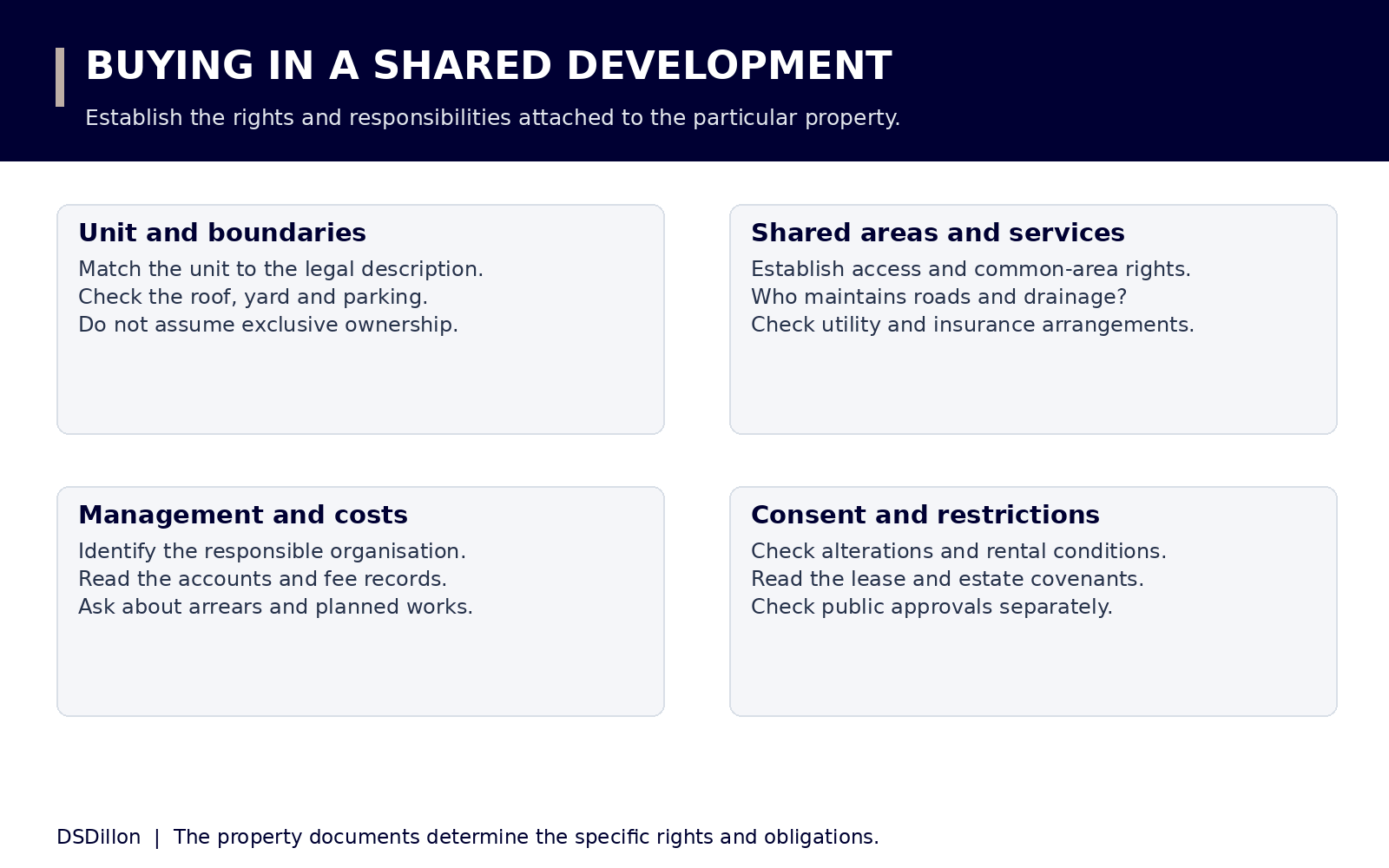
Use this diagram to organise the documents you request. The allocation of ownership, use and responsibility must be established for the particular development.
Step 2: identify the unit, common areas and exclusive-use spaces
Have the attorney and relevant technical professional match the unit description with the plans and the physical property. A parking bay, terrace, garden, roof or storage room may be included in the unit, reserved as shared property, or available under a particular right of use. Establish which applies.
Ask who may use each space, who may maintain or alter it, and whether its use can be reassigned. Record any discrepancy between the listing, viewing and documents. A fence around a garden does not by itself establish that the garden is included in the sale.
- Unit number, floor, dimensions and the limits described in the legal instrument.
- Balconies, patios, gardens, roof spaces and storage areas.
- Parking allocation, visitor parking and vehicle access.
- Shared stairs, lifts, corridors, roads, drains, meters and service routes.
- Rights needed to enter neighbouring or common areas for repairs.
Step 3: investigate the management arrangements
Identify the entity or people responsible for managing the development. Ask for the governing documents, current rules, budgets, accounts and available meeting records relevant to the purchase. Establish how decisions are made and what voting, shareholding or membership rights transfer.
Ask about unresolved disputes, arrears, major repair proposals and the condition of common assets. These are purchase enquiries; the documents and applicable law determine what the buyer is entitled to receive and what obligations can be enforced.
The existence of a management company does not prove that it owns all common property. In Rainbow Court, the Privy Council described management authority conferred by agency while the property interest remained with the lessor. Check ownership and management authority separately.
Step 4: establish management fees and other charges
Request a written schedule of the current charges and what they cover. Ask how increases are approved, whether major works are funded separately, what balances are outstanding for the unit, and how liability is allocated at completion.
Review the contract and management documents with your attorney. Do not assume that a low advertised monthly fee covers roof replacement, lift repairs, insurance, water infrastructure or all future works. Obtain the information needed to judge the actual commitment.
| Item to ask about | Why it matters |
|---|---|
| Regular maintenance or service charge | Shows the recurring commitment and services included. |
| Lease rent, where applicable | May be payable separately from management charges. |
| Building insurance | Establish the insured property, policy arrangements, excesses and any additional cover needed. |
| Reserve or major-works funding | Establish how substantial future repairs are funded. |
| Unit arrears and pending charges | Have the sale agreement address responsibility and evidence of settlement. |
Step 5: check alteration and occupation rules
Read the restrictions relevant to your plans, including extensions, windows, doors, roofing, air-conditioning equipment, pets, parking, business activity and short-stay letting. Ask which consents are required and who has authority to give them.
TCPD’s townhouse guidance addresses structural alterations and additions. It covers matters such as the location and compatibility of additions, privacy, light, ventilation and access. Planning requirements and private lease or management consents must both be considered.
In East Park Villas Ltd v Thomas, the High Court examined a development’s lease covenants governing written consent, nuisance and planning compliance. The practical question for a buyer is what the actual covenant says and whether the relevant approval has been obtained.
Can you rent out a condo or townhouse?
Check the lease, covenants, management rules and applicable planning position before relying on rental income. Establish whether the intended arrangement is a residential tenancy, holiday letting, room-by-room occupation or another activity.
If the property already has tenants, obtain the agreements and records and have your attorney explain what passes to you on purchase. If vacant possession is required, ensure the contract addresses it. Do not rely on an informal promise that occupants will leave.
Step 6: inspect both the unit and the shared building
Arrange an appropriate inspection of the unit and enquiries about shared structures and services. Ask about roof leaks, drainage, retaining structures, water storage, pumps, lifts, electrical systems and access for maintenance where relevant.
For stairs or lifts, test whether the actual route meets the intended occupants’ needs. Consider deliveries, parking and emergency access. Attractive finishes inside a unit do not answer questions about the condition and funding of common assets.
What if the property is an HDC home?
HDC publishes a consent procedure for sales and other assignments. Its application requests property and transaction documents and includes lease-rent and management-fee information where relevant. Have the attorney identify the applicable consent and assignment requirements for the particular HDC interest.
The appearance of the home does not establish whether an owner can transfer it without consent. Obtain the lease and HDC records and confirm the current requirements before treating a proposed resale as ready to complete.
Questions to answer before choosing a home
Compare the particular homes using the same evidence. A well-managed apartment can meet one buyer’s needs, while a detached house or townhouse may better suit another. The decision should reflect the actual layout, obligations, condition and intended use.
- Can the seller transfer the precise interest being offered?
- Are the areas and facilities I expect to use included or legally available?
- Are the current building and intended use authorised?
- Can I meet the ongoing charges and foreseeable repair obligations?
- Do the rules allow the changes, occupation and letting arrangements I need?
- Have the attorney, inspector, surveyor, valuer and lender resolved the issues relevant to their roles?
Discuss your land project
Tell us the location, the documents you hold and the development you have in mind.
Contact DSDillonThis guide provides general information. Obtain advice on the title, lease, site and approvals for your particular proposal.